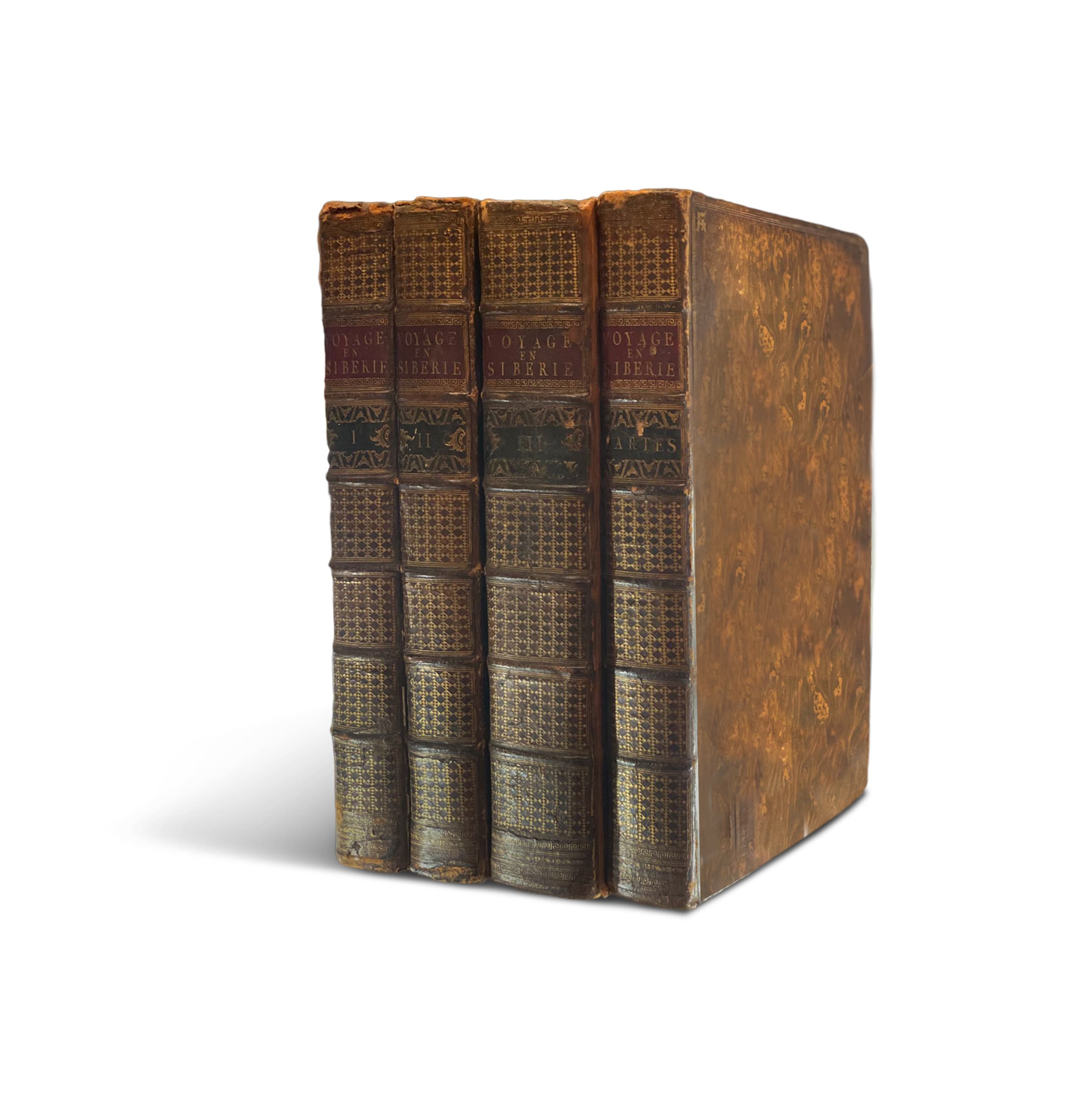
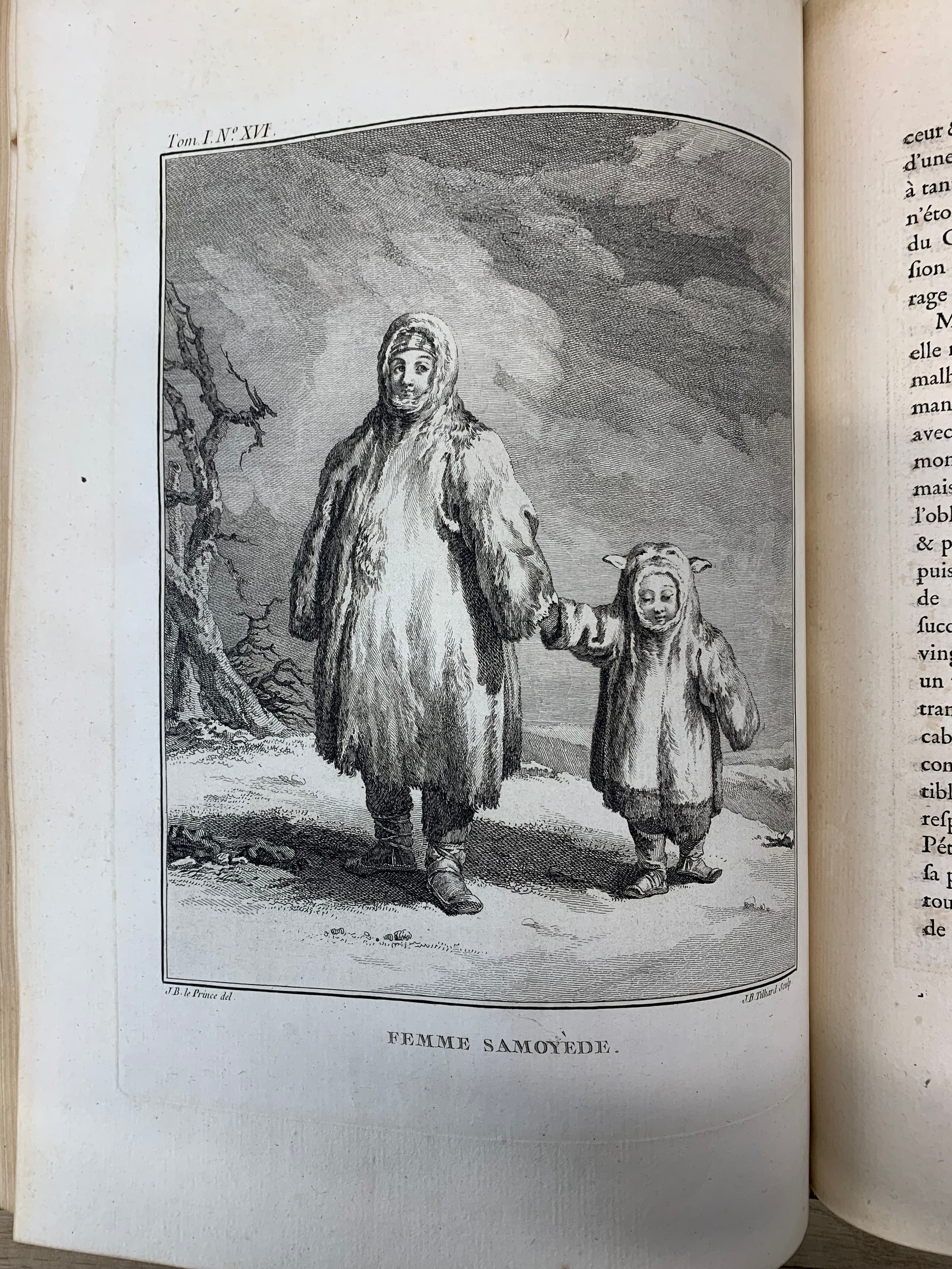
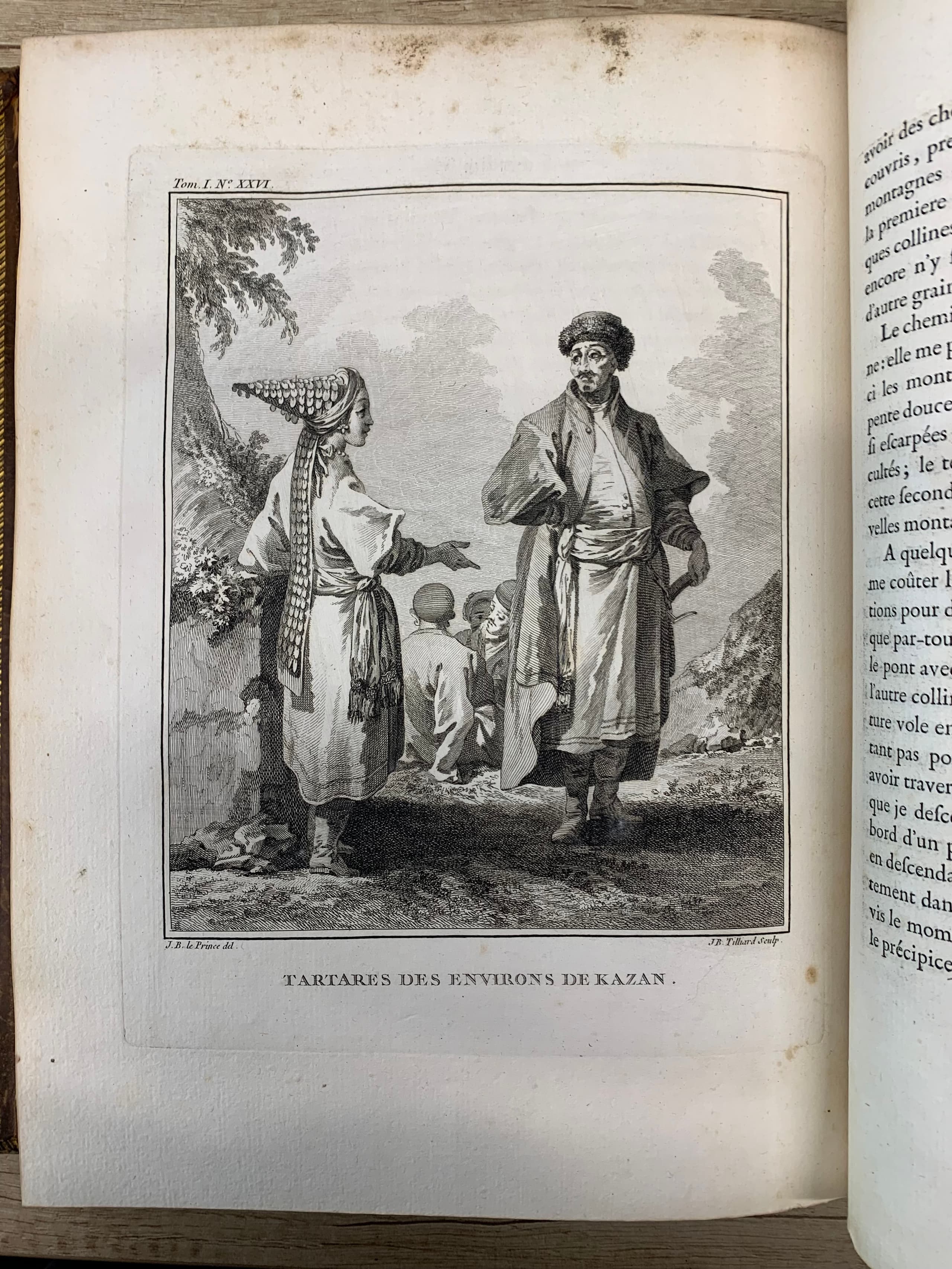
CHAPPE D'AUTEROCHE, JEAN-BAPTISTE (1728-1769) Voyage en Siberie, fait par ordre du Roi en 1761 contenant les moeurs, les usages des Russes, et l'etat actuel de cette puissance; la description geographique & le nivellement de la route de Paris a Tobolsk, l'histoire naturelle de la meme route, des observations astronomiques etc., enrichi de cartes geographiques, de plans, de profils du terrain; de gravures qui representent les usages des russes, leurs moeurs, leurs habillements, les divinites des Kalmouks et plusieurs morceaux d'histoire naturelle. Par l'abbe Chappe d'Auteroche. Illustr. after Moreau le Jeune and Le Prince. Paris, chez Debure, 1768. First edition. A genuine bibliographic rarity.
Lotto 638
6 0008 000

In French.
Vol. 1. 347 pp.: ill., 28 ill. sheets; Vol. 1. Part 2. 677 pp.: ill., 34 ill. sheets. Vol. 2. 627 pp.: ill., 17 ill. sheets; 32.1 x 23.8 cm. Atlas. [1768]. - frontispiece, 33 sheets of plans and maps; 32.4 x 24.1 cm.
Two volumes in three books and an Atlas. The first volume is divided into two parts, the second contains a translation of S.P. Krasheninnikov's work ‘Description of the Land of Kamchatka’ .
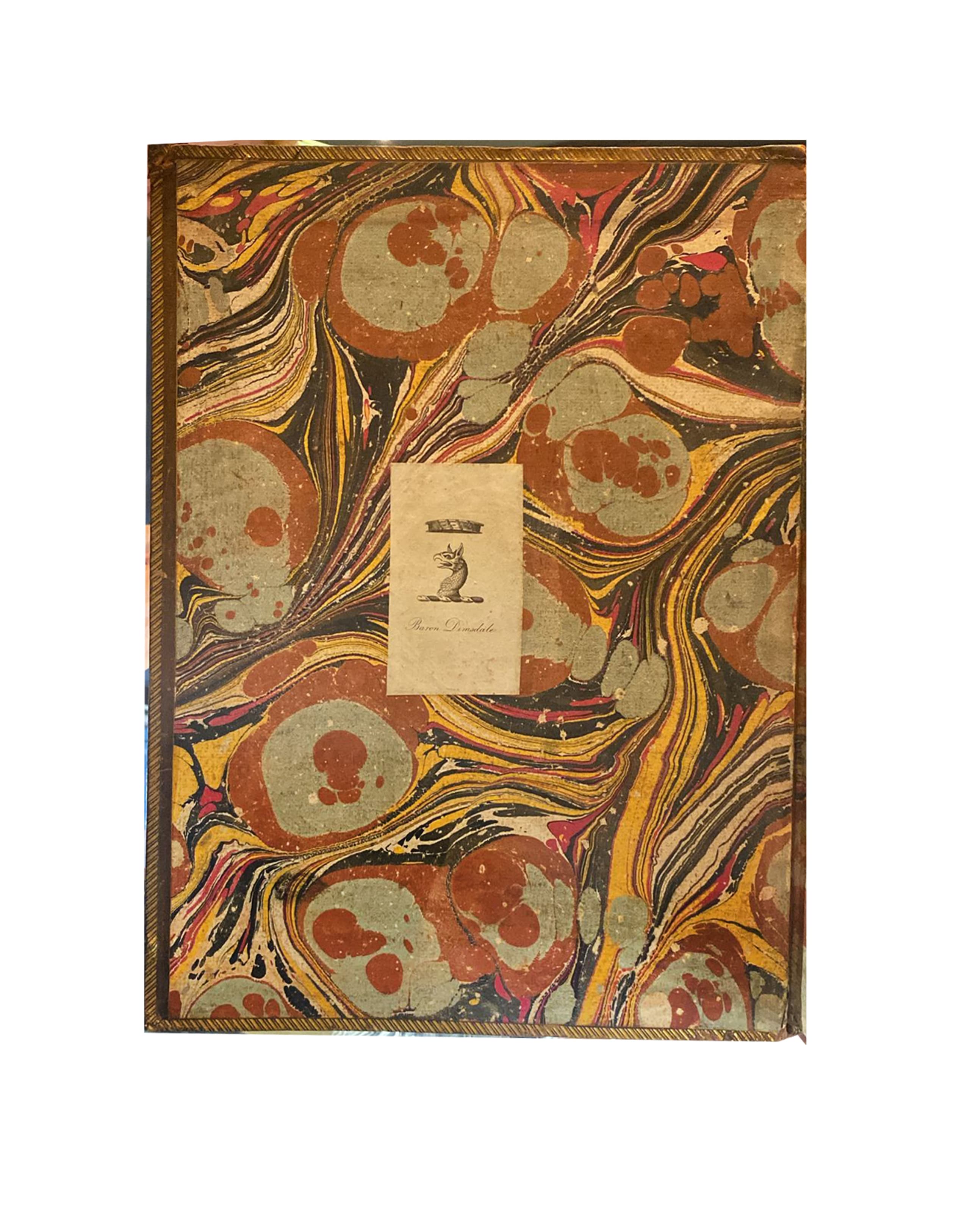
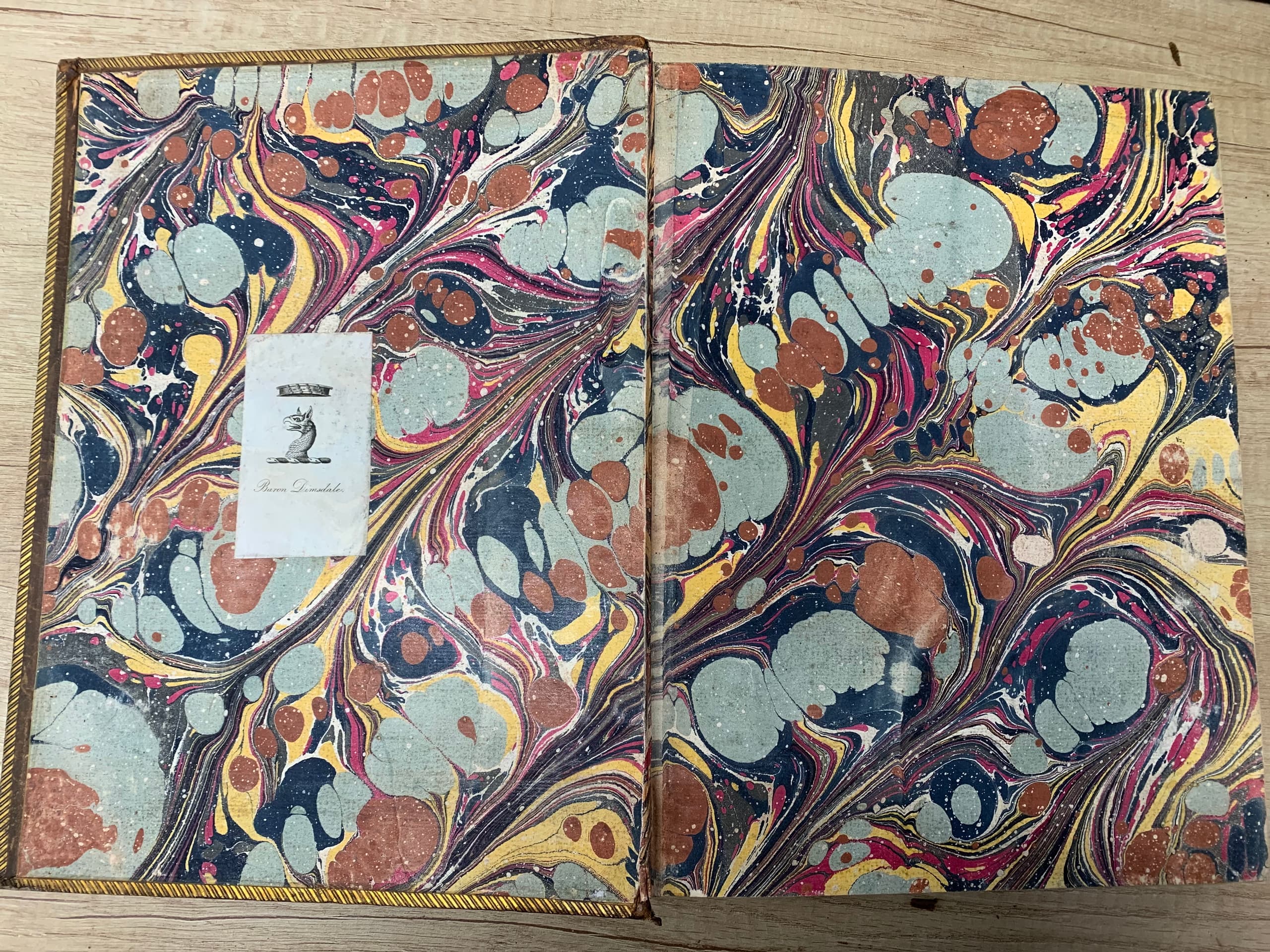
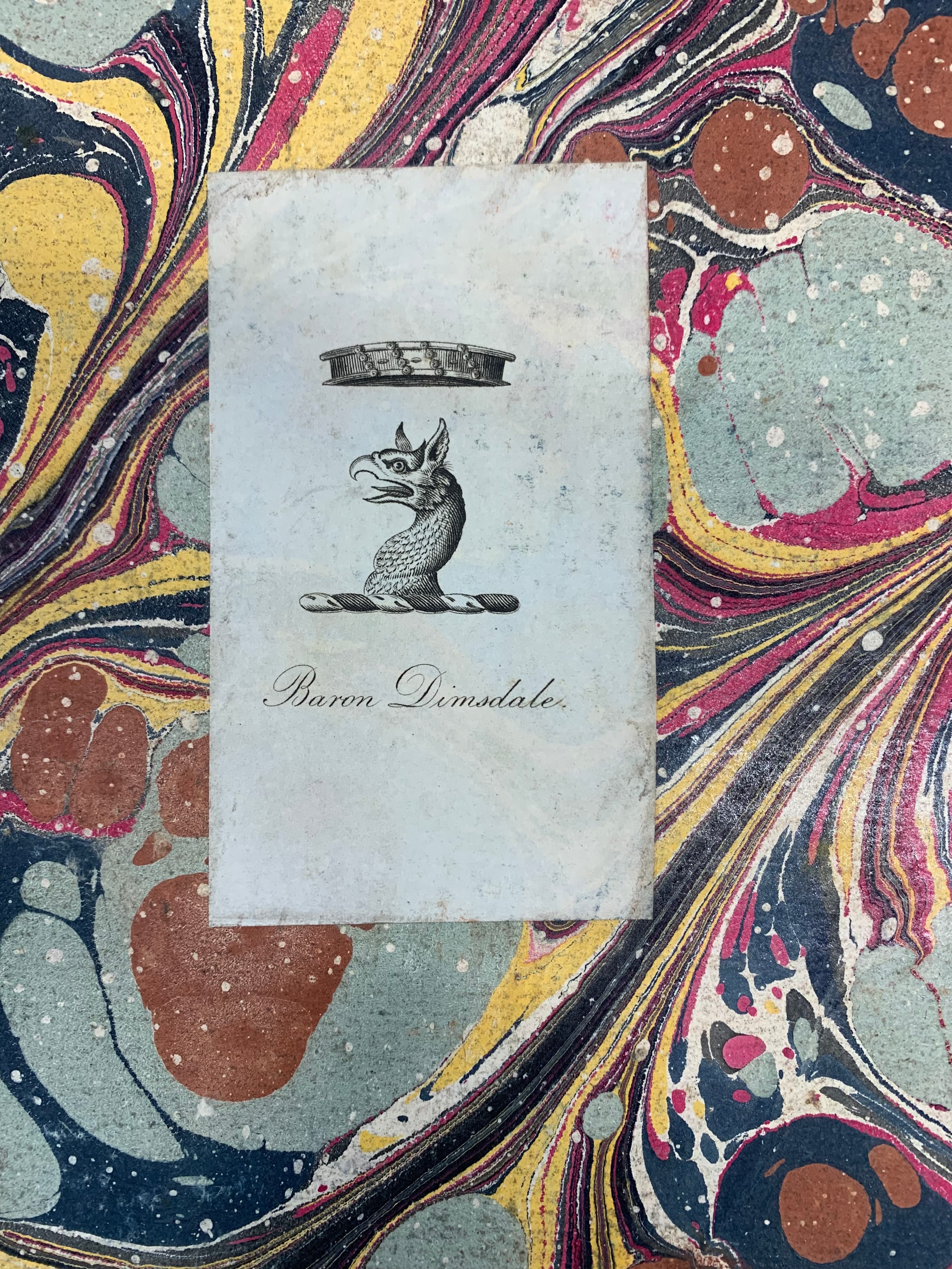
The illustrations are copperplate engravings after drawings by Jean-Baptiste Le Prince, who accompanied the scientist on his journey. In contemporary full leather (morocco) bindings with rich gold embossing. Endpapers with ‘peacock feather’ pattern and engraved bookplates. In good condition. Some wear. The engraved bookplates depicting a griffin's head under a stylised Russian crown on the endpapers are the mark of ownership of Baron Thomas Dimsdale (1712–1800).
First edition. A genuine bibliographic rarity.
Provenance: Baron Thomas Dimsdale (1712-1800) was an English physician who was summoned from London in 1768 to introduce smallpox vaccinations in Russia. Empress Catherine II, aware of the danger of smallpox infection, ordered that she and Grand Duke Paul Petrovich be vaccinated. The upcoming event was kept strictly secret. The Empress travelled to Tsarskoye Selo, where Dimsdale vaccinated her. The recovery of the Empress and her son was a significant event in the life of the Russian court.
In 1761, Jean-Baptiste Chappe d'Auteroche travelled to Tobolsk to observe a rare astronomical phenomenon, stayed in Russia for about a year, and in 1768 published a luxurious book in Paris on exquisite paper with magnificent illustrations. The abbot was accompanied on his journey by Boucher's pupil, the artist Jean-Baptiste Le Prince, who was working in Russia at the time. Le Prince, ‘translated’ his sketches into etchings and engravings, illustrating the abbot's work and turning the traveller's book into a true masterpiece of Rococo art. The fifty-six engravings by Le Prince, that adorned the folios became a lasting historical document, testifying to the most diverse aspects of Russian life in the 18th century.
In Russia, a detailed critique of the book was published. Four years before the publication of ‘Travels in Siberia,’ M.V. Lomonosov called the abbot ‘an ill-wisher of Russia,’ as if anticipating the content. The abbot's narrative caused the greatest outrage among the Russian empress herself. Catherine II, who had ruled since 1762, believed that the description of Russia seven years earlier would cast a shadow on all her reforms, and published (anonymously) the book Antidote (Antidote), which contained a detailed analysis and refutation of Chappe's biased opinions about Russia, with the subtitle ‘An analysis of a bad but beautifully printed book...’.
Jean Chappe d'Auteroche was a French astronomer and traveller. He pioneered a new literary genre — travel notes — which would enjoy incredible popularity in the 19th century.