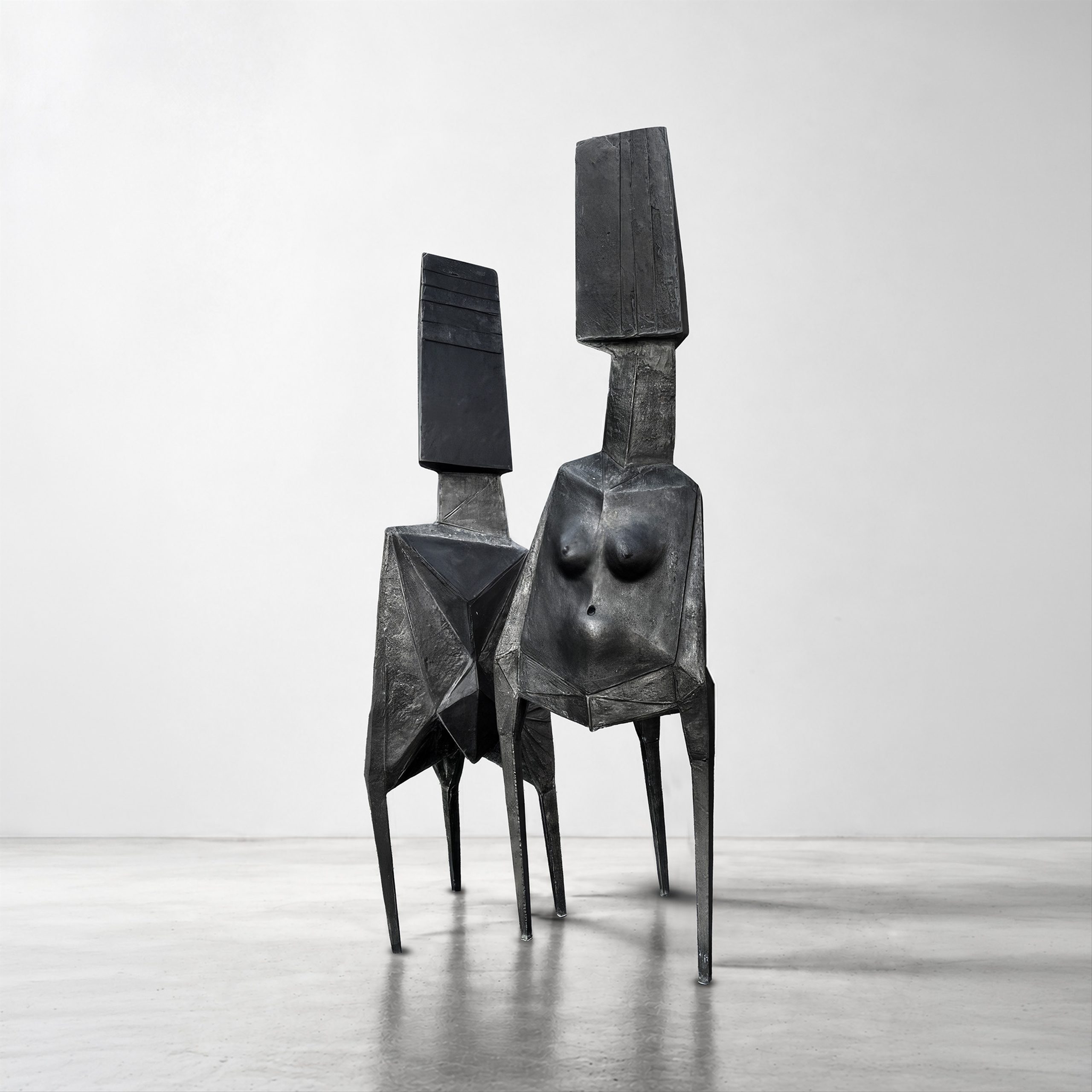
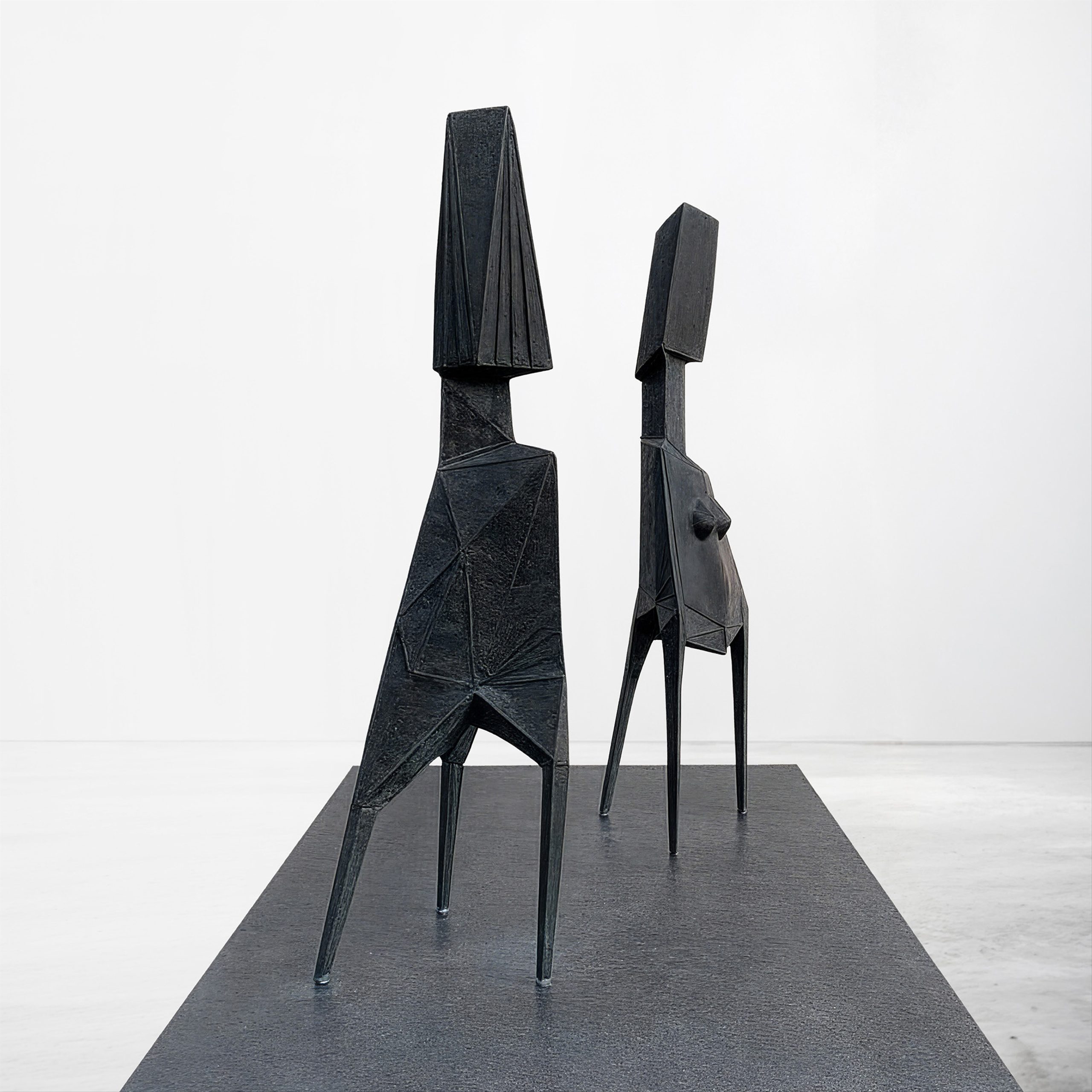
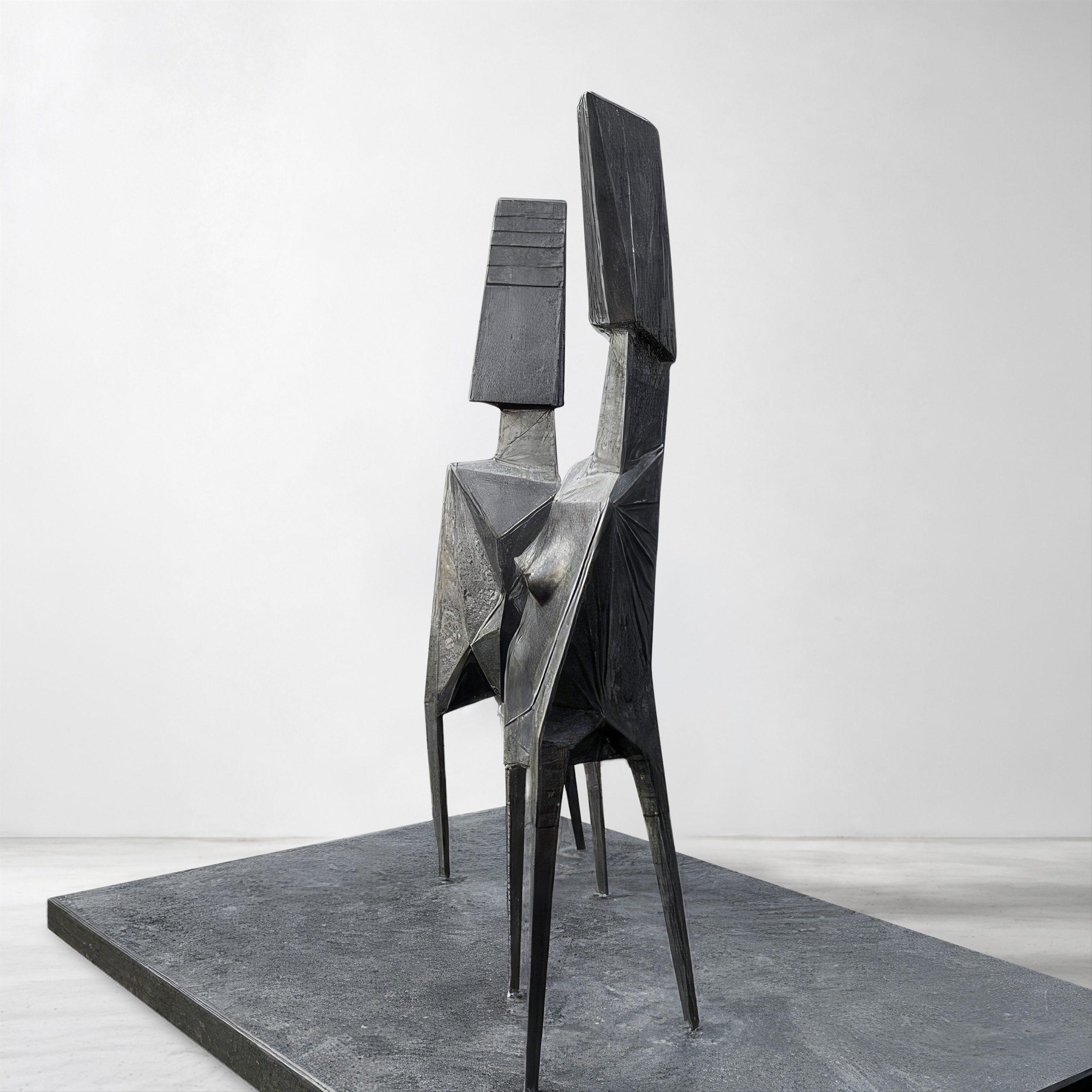
LYNN CHADWICK (1914–2003) High Hat Man and High Hat Woman, 1968
Лот 27
2 500 0002 700 000
bronze
edition 1/4
H. 232 cm and 237 cm, respectively
Conceived in 1968, the present sculptures are from an edition of four.
PROVENANCE:
The Estate of the Artist
Finartis Kunsthandels AG, Switzerland
Private Collection
LITERATURE:
D. Farr and E. Chadwick, Lynn Chadwick, Sculptor: With a Complete Illustrated Catalogue 1947–2005, Lund Humphries, London, 2006, nos. 570 and 571, p. 258 (other casts illustrated).
EXHIBITED:
Osborne Samuel Gallery, London, 2004 (illustrated).
High Hat Man and High Hat Woman, two monumental bronze sculptures, were conceived in 1968, at the height of Lynn Chadwick’s mature practice. The pair reflects the artist’s sustained interest in the human figure and the relationship between forms. The male figure, with its broad, rectangular torso, contrasts with the more slender and elongated female, distinguished by her narrow neck, longer legs and subtly modelled breasts and abdomen. Both wear distinctive geometric high hats. Their angular bodies and attenuated limbs reduce the human figure to a few essential geometric forms, while differences in posture and proportion suggest a psychological relationship between the two. Chadwick captures an elusive sense of ‘attitude’ through the subtle interplay of their forms. Evoking Jungian archetypes of the masculine and feminine, the pair reflects Chadwick’s exploration of standing, sitting and reclining couples, a recurring theme in his work from the mid-1950s onwards.
Chadwick’s method was instinctive and experimental. He developed his sculptures directly in three dimensions, generally without preparatory drawings, this working method was similar to the artistic principles of automatism, art informel and Abstract Expressionism. Forms emerged through construction rather than from a predetermined design. He welded steel rods into open frameworks, a process he described as 'drawing in steel rods', before applying Stolit, a compound of gypsum and iron filings, to create surfaces that could be worked smooth or textured. The models were subsequently cast in bronze. Although this was an expensive and technically complex process, making the production of sculptures on this scale particularly demanding, bronze came to dominate his practice from the late 1950s onwards.
Chadwick regarded colour as a potential distraction, preferring the effects of patina, surface texture and, occasionally, polished bronze facets. His combination of rigid geometric frameworks and organic forms also recalls the biomorphic tendencies of post-war abstraction.
Chadwick had no formal training as a sculptor. He trained as an architectural draughtsman and worked in architectural practices before turning to sculpture. Following the Second World War, his collaboration with the architect Rodney Thomas prompted his first experiments with mobiles, at a time when Alexander Calder's work was still relatively unfamiliar in Britain, as Chadwick later recalled. In 1950, seeking the technical skills needed to produce larger works, he attended a welding course at the British Oxygen Company's Welding School in Cricklewood, London, where he learned to work with iron, steel, brass and copper. His work subsequently developed from mobiles and open constructions into solid sculpture. For many years, Chadwick personally undertook much of the technical production of his sculptures; he established his own foundry at Lypiatt Park in 1971, principally for jewellery and smaller bronzes.
Chadwick first came to international prominence in 1952, when he exhibited in the British Pavilion at the XXVI Venice Biennale, alongside a new generation of British sculptors associated with Herbert Read’s celebrated Geometry of Fear. Their angular, often skeletal forms reflected the anxieties of post-war Europe, a context in which Chadwick's early sculptures were widely understood. At the 1956 Venice Biennale, he received the International Prize for Sculpture, ahead of Alberto Giacometti and Cesar, becoming its youngest-ever recipient. He was appointed Commander of the Order of the British Empire (CBE) in 1964.
Conceived twelve years after his triumph at Venice, the present pair brings together the ar-chitectural clarity of his constructions, the material richness of his mature bronzes and his sustained interest in the psychological relationship between human figures. Standing over two metres high and combining geometric abstraction with a distinctly human presence, High Hat Man and High Hat Woman exemplify the monumental yet expressive character of Chadwick’s mature sculptural language.