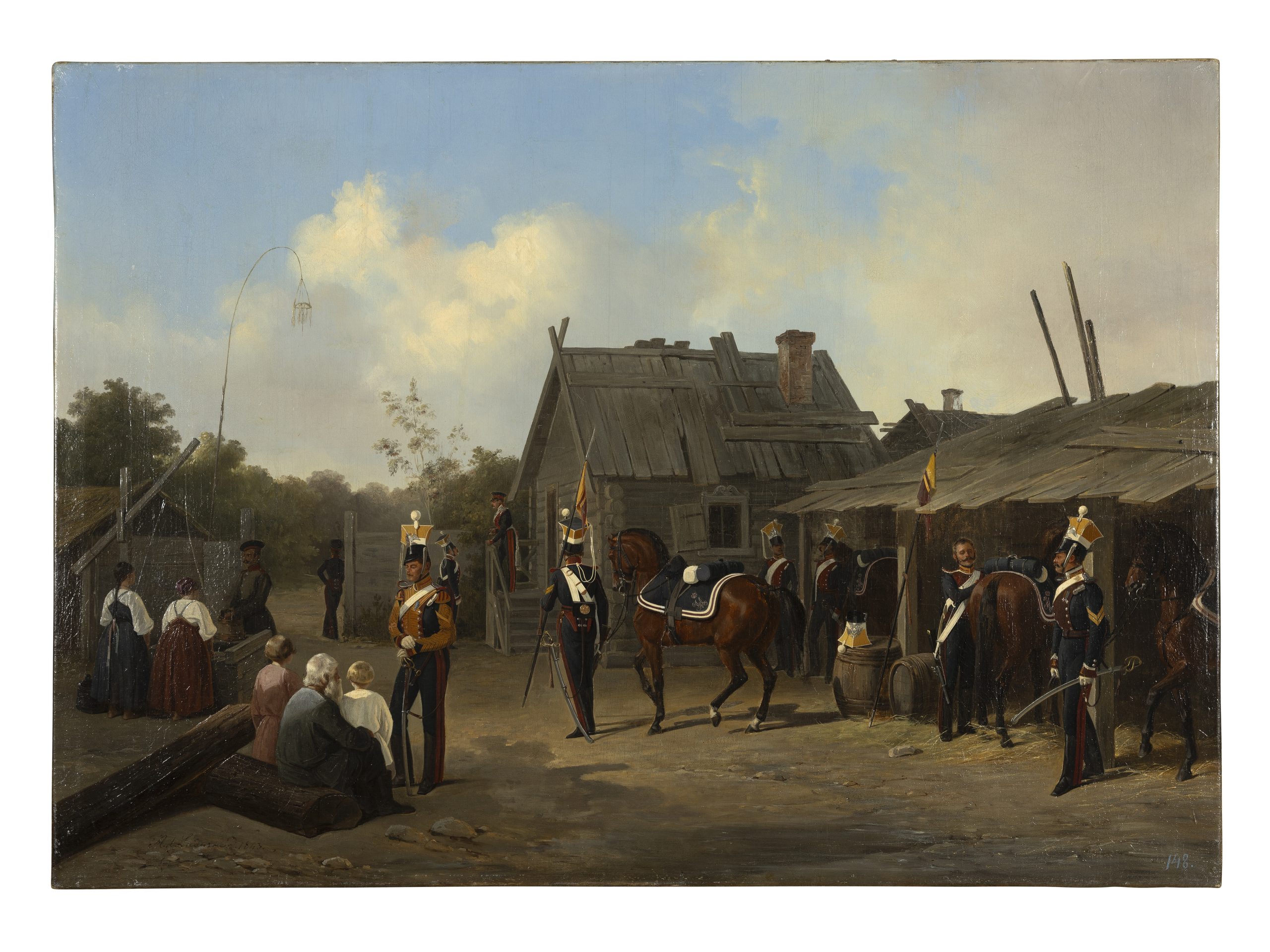
[FROM THE COLLECTION OF EMPEROR NICHOLAS I] ADOLPHE IGNATIEVICH LADURNER (1798–1855) The Life Guards Uhlan regiment of His Imperial Highness Grand Duke Mikhail Pavlovich in camp at Krasnoye Selo
Lotto 99
100 000120 000
![[FROM THE COLLECTION OF EMPEROR NICHOLAS I] ADOLPHE IGNATIEVICH LADURNER (1798–1855)
The Life Guards Uhlan regiment of His Imperial Highness Grand Duke Mikhail Pavlovich in camp at Krasnoye Selo](https://cdn.hermitagefineart.net/objects/d9/f1/d9/d9f1d9412136309cdf4e455c59b13432_w2560.jpg)
signed and dated ‘Ad. Ladurner 1843’ (lower left); inventory number ‘148.’ (lower right)
oil on canvas
69 × 97.5 cm
Painted in 1843
PROVENANCE:
Collection of Emperor Nicholas I, Aleksandrovsky Palace, Tsarskoye Selo. Sotheby’s London, The Russian Sale, 14 December 1995, lot 135.
Sotheby’s London, 28 May 2012, lot 4.
Private collection.
LITERATURE:
Podstanitsky, S. A., Leonov, O. G. and Popov, S. A., The Russian Guard in the Paintings of Adolf Ladurner. Moscow: Russkie Vityazi Publishing House, 2017, pp. 100–103, ill.
Adolphe Ladurner was a French-born painter specialising in military and historical scenes. A pupil of Horace Vernet, he exhibited at the Paris Salon before settling in Saint Petersburg in 1830, where he enjoyed the patronage of Emperor Nicholas I and became known for his depictions of military parades, manoeuvres, camp scenes and Russian army uniforms. In 1836, he was appointed an Academician of the Imperial Academy of Arts, and in 1840, a professor. His works are held in several Russian imperial collections, notably the Russian Museum in Saint Petersburg.
Formed in 1817 for the Guards detachment in Warsaw, the Guard Uhlan Regiment of Tsarevich Konstantin Pavlovich passed, following Konstantin’s death in 1831, under the patronage of Grand Duke Mikhail Pavlovich. Upon the death of Mikhail Pavlovich in 1849, the regiment’s chief became the heir, Tsarevich Alexander Nikolaevich. Following his accession to the throne in 1855, the regiment was renamed the Guard Uhlan Regiment of His Majesty, a name it retained until 1917.
The painting depicts ‘Warsaw’ Uhlans of the Guard quartered in a peasant courtyard (during the Krasnoye Selo manoeuvres, cavalrymen, unlike infantrymen, were generally billeted not under canvas but in village courtyards). With the exception of a Uhlan in a greatcoat (at left, near the well) and a soldier in ‘undress’ uniform (near the gateway), all the others are in parade uniform and appear to be preparing to form ranks: the junior officer standing on the steps (he has replaced his parade shako with a cap), two non-commissioned officers (one, at right, is leading a horse out from beneath the canopy, while the other stands in front of the steps), the squadron trumpeter (speaking with an old man and children), and the rank-and-file soldiers. On the chest of the non-commissioned officer in the foreground are the Military Order decoration and the 5th Class Virtuti Militari Cross, awarded for the Polish campaign of 1830–1831; the same cross is visible on the trumpeter’s chest. The regiment traditionally rode bay horses.