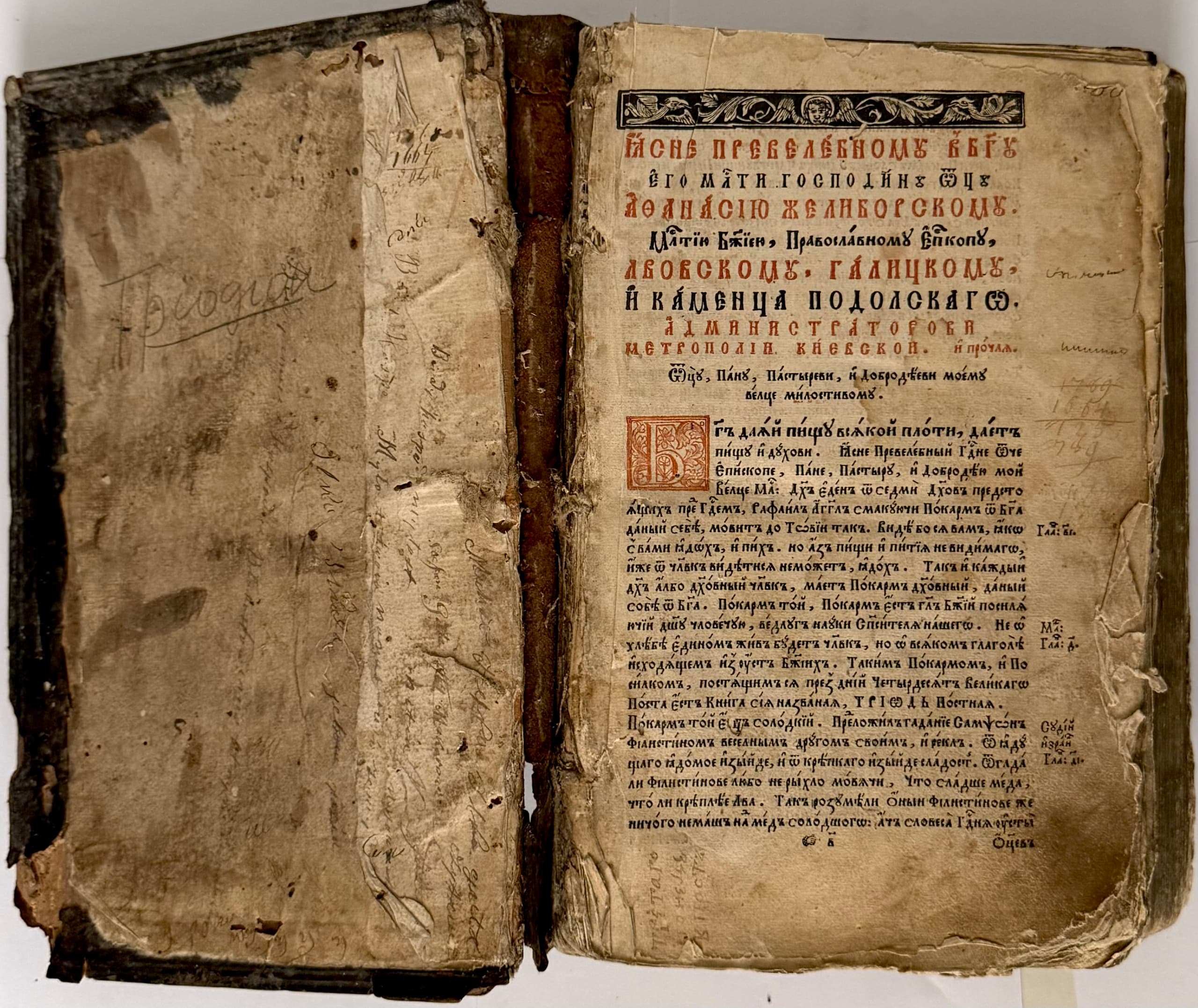
MIKHAIL SLEZKA (Mykhailo Slozka) (?–1667) Triodion si est: Tripesnets, s[vya]toy velikoy chetyredesyatnitsi. V Lvove: v drukarni Mikhaila Sliozki, izhdiveniem episkopa Afanasiya Zheliborskogo, [The Tri-odion, that is: The Book of Three Songs, for the Great Lent]. In Lviv: at the printing house of Mikhail Slezka, sponsored by Bishop Afanasy Zheliborsky, 1664.
Lotto 935
1 7002 000
![MIKHAIL SLEZKA (Mykhailo Slozka) (?–1667)
Triodion si est: Tripesnets, s[vya]toy velikoy chetyredesyatnitsi. V Lvove: v drukarni Mikhaila Sliozki, izhdiveniem episkopa Afanasiya Zheliborskogo, [The Tri-odion, that is: The Book of Three Songs, for the Great Lent]. In Lviv: at the printing house of Mikhail Slezka, sponsored by Bishop Afanasy Zheliborsky, 1664.](https://cdn.hermitagefineart.net/lots/23/a1/31/23a131996344_w2560.jpg)
![MIKHAIL SLEZKA (Mykhailo Slozka) (?–1667)
Triodion si est: Tripesnets, s[vya]toy velikoy chetyredesyatnitsi. V Lvove: v drukarni Mikhaila Sliozki, izhdiveniem episkopa Afanasiya Zheliborskogo, [The Tri-odion, that is: The Book of Three Songs, for the Great Lent]. In Lviv: at the printing house of Mikhail Slezka, sponsored by Bishop Afanasy Zheliborsky, 1664.](https://cdn.hermitagefineart.net/lots/69/f5/61/69f561e447c0_w2560.jpg)
![MIKHAIL SLEZKA (Mykhailo Slozka) (?–1667)
Triodion si est: Tripesnets, s[vya]toy velikoy chetyredesyatnitsi. V Lvove: v drukarni Mikhaila Sliozki, izhdiveniem episkopa Afanasiya Zheliborskogo, [The Tri-odion, that is: The Book of Three Songs, for the Great Lent]. In Lviv: at the printing house of Mikhail Slezka, sponsored by Bishop Afanasy Zheliborsky, 1664.](https://cdn.hermitagefineart.net/lots/9c/25/f2/9c25f23d9dfd_w2560.jpg)
2–6 nn., 1–453 fol.; 2°.)
Contemporary binding: boards, leather with blind-stamped embossing.
The engravings in the text are executed in the characteris-tic manner of the Lviv school, distinguished by fine lines and attention to details of garments and interiors. The volume is richly decorated with numerous headpieces fea-turing lavish floral and geometric ornamentation in the style of the late Renaissance and early Baroque, as well as initials (monograms).
In good condition. Fragments of the leather binding re-stored, tears of leaves reinforced, rare losses repaired, soiling, water stains, rare losses of leaf fragments with minor damage to the text have been pasted over with paper (all restoration work dates from the 18th–19th centuries), and traces of wax. The first title page bearing the coat of arms of the Zheliborski family on the reverse is missing.
Inserted notes and numerous ownership inscriptions in the margins, 17th–19th centuries.
Mikhail Slezka – an outstanding West Ruthenian printer and publisher of the first half of the 17th century. A native of Vil-nius, he arrived in Lviv as a young man ‘with nothing but a knapsack’, and from 1630 began working at the printing house of the Lviv Assumption Stavropegic Brotherhood; in 1633 he became a member and soon headed its printing operations. He was a talented printer, writer (author of numerous dedications, prefaces and afterwords), bookbinder and bookseller. Tired of the control exercised by the Lviv Brotherhood, Slezka left the brotherhood’s printing house and founded his own in 1638.
Mikhail Slezka produced around 20 publications, more than any of his contemporaries working in the region’s printing houses.
This unique monument of 17th-century Slavic Cyrillic printing possesses high cultural, artistic, scientific and material val-ue; it ranks among the book monuments of national signifi-cance