VARVARA STEPANOVA (1894-1958) Cityscape Moscow. View from the window
Lotto 174
10 00015 000
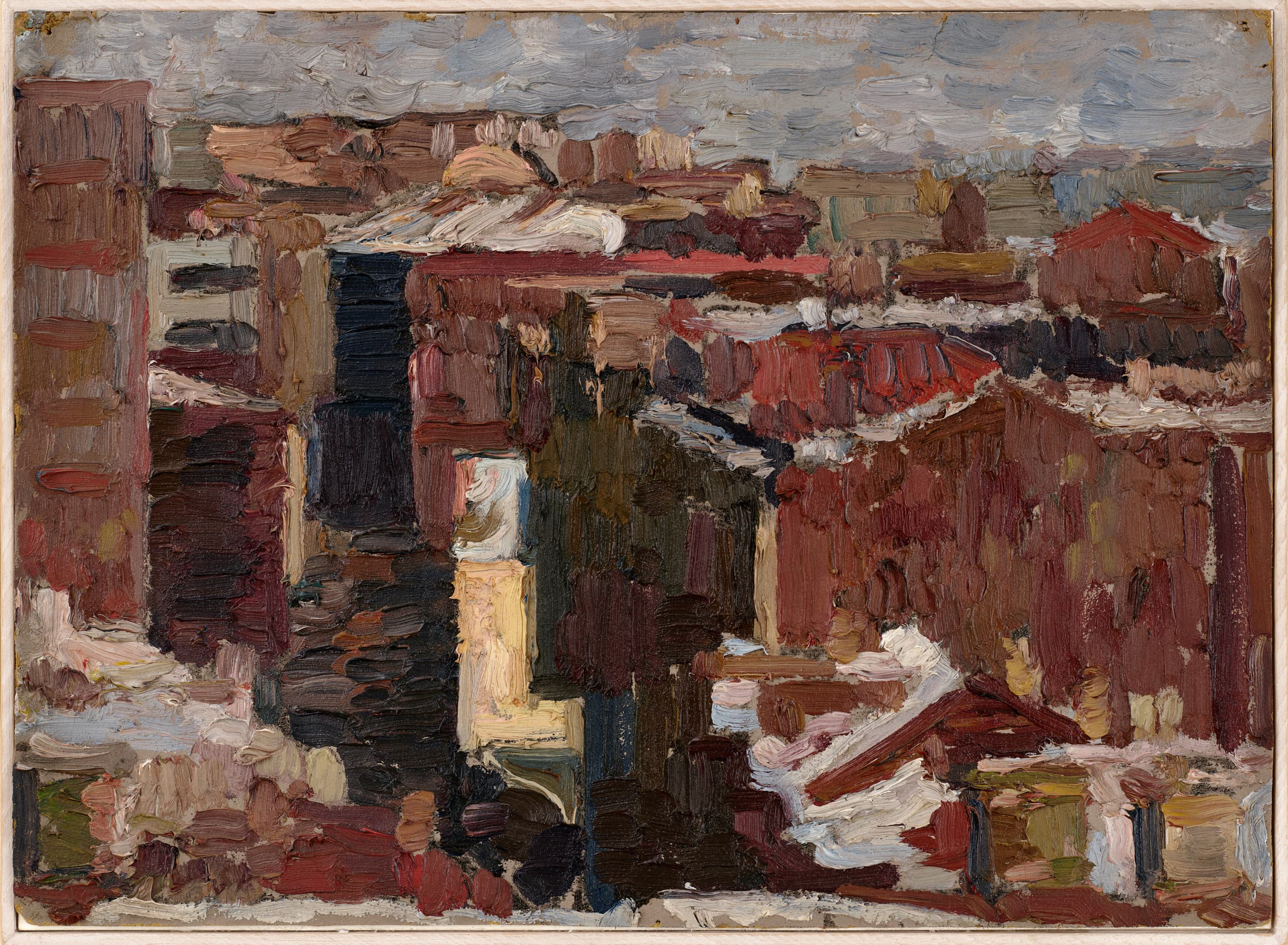
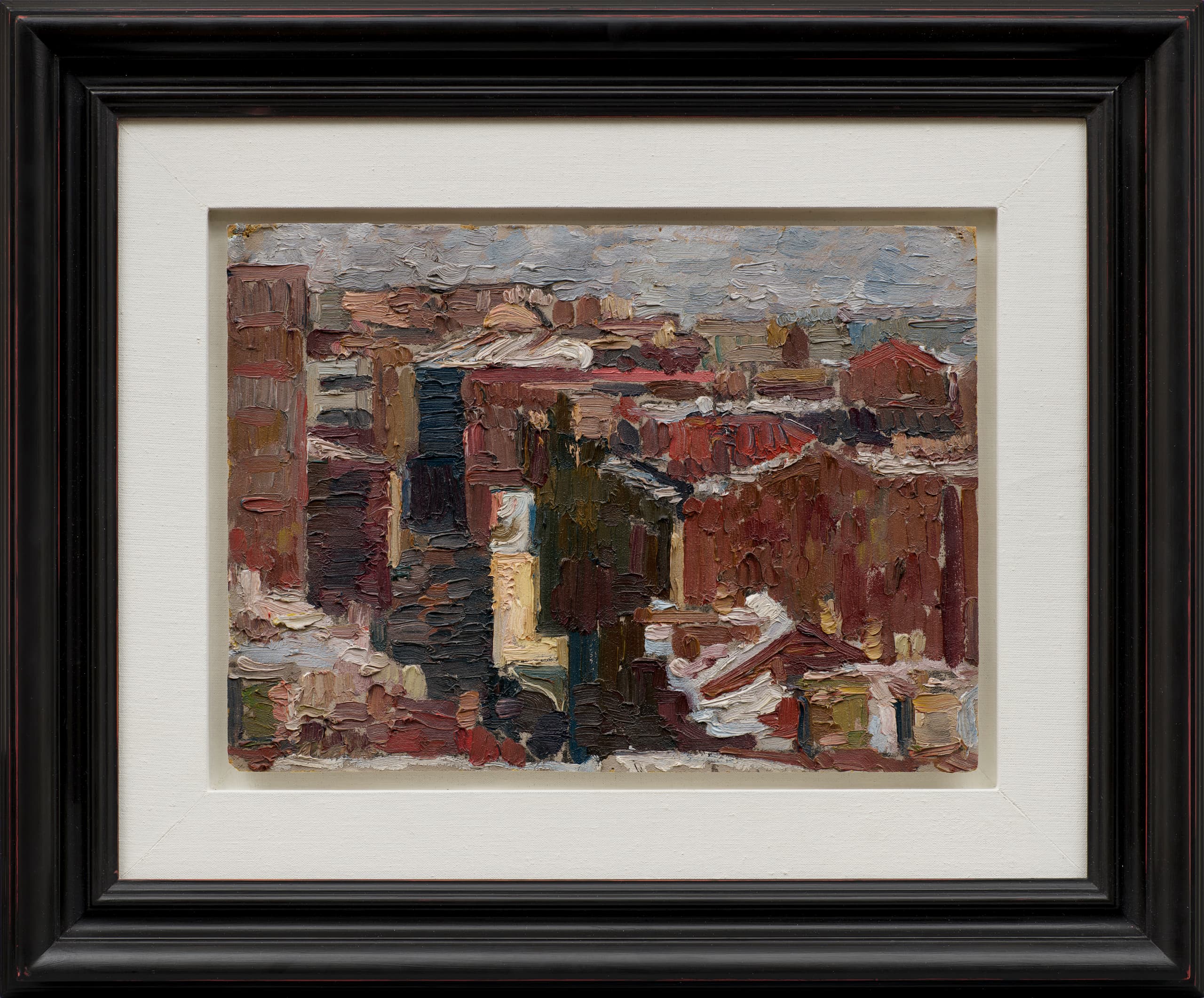
signed, dated and titled in Cyrillic ‘Stepanova / View from the window 1938 / VARVARA STEPANOVA / 27 x 37 / Landscape from the window V. F. Stepanova 1938’ (on reverse)
oil on board
27.1 x 37.3 cm
painted in 1938
Provenance:
Estate of the artist
Private collection
Certificate of authenticity by Alexander Lavrentiev, grandson of Alexander Rodchenko and Varvara Stepanova, Professor of the Department of Communication Design of the Moscow State Stroganov Academy of Design Art, Ph.D., 24 August 1995
The present painting by Varvara Stepanova belongs to the late period of the artist’s career. After 1934, when Joseph Stalin proclaimed the primacy of Socialist Realism, Stepanova’s artistic activity significantly declined amid increasingly strict censorship. During this period, she focused primarily on design and editorial work. Although she returned to studio painting in the late 1930s, her approach had markedly changed. Moving away from the experimental and constructivist language that had defined her earlier work, she adopted a more restrained style, gravitating toward a form of realism infused with subtle impressionistic qualities. Among her final works are the ‘Moscow Views’ (1938), executed in a more classical manner. These compositions depict bright rooftops rendered with a strong sense of perspective, while a calm, soothing atmosphere is conveyed through delicate greenish and pastel tones.
Varvara Rodchenko, the artist’s daughter, recalled: ‘Stepanova painted the view from the studio window in the 1930s. She applied the paint thickly. The layers of paint (‘fuza’) left on the palette were used by my father to prime cardboard for his studies.’
The studio was located on Myasnitskaya Street in Moscow. According to Alexander Lavrentiev, Stepanova was particularly fond of the northern view, which included a brown building constructed in 1933 by Le Corbusier and Nikolai Kolli. Lavrentiev further notes: ‘In her urban and suburban landscapes, as well as in her still lifes, she conveyed a sense of rest, stability, and balance. In her late paintings, the artist distances herself from the dynamism and geometrization of her earlier works. These works were likely essential for her to rediscover herself, to recover after the intense demands of approving sketches and reworking photographic albums.’
Comparable works from this period can be found in the Department of Private Collections at the Pushkin State Museum of Fine Arts.
Questo lotto è in importazione temporanea ed è soggetto a tassa di importazione (5,5%) (UE) e spese amministrative doganali.