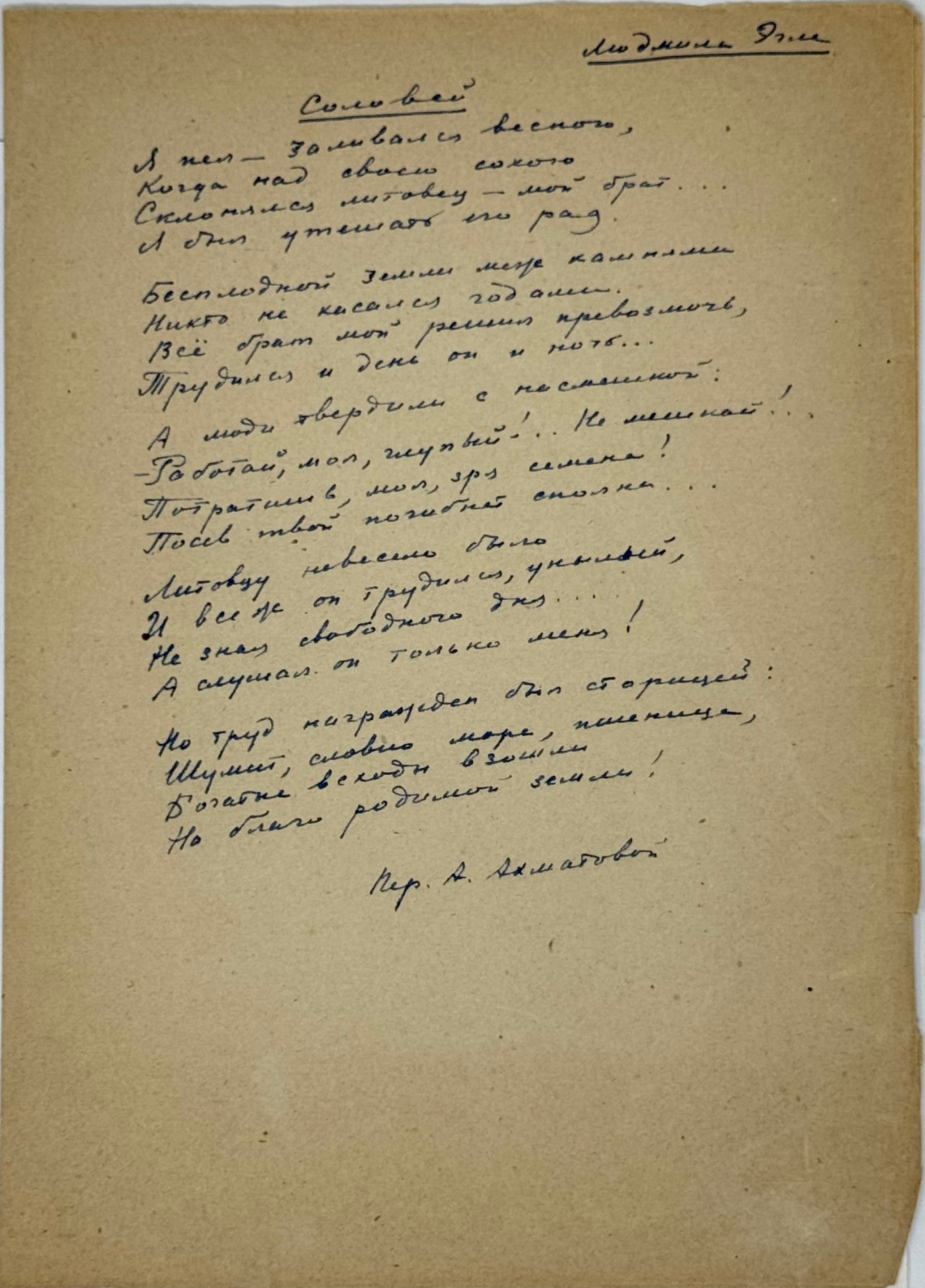
AKHMATOVA ANNA ANDREYEVNA (1889–1966), AUTOGRAPH The manuscript of the translation of the poem 'Solovey' [The Nightingale] by Lyudmila Egle. 1960. At the end of the text in Cyrillic: 'Per. A. Akhmatova.'
Lotto 742
5 0006 000
![AKHMATOVA ANNA ANDREYEVNA (1889–1966), AUTOGRAPH
The manuscript of the translation of the poem 'Solovey' [The Nightingale] by Lyudmila Egle. 1960. At the end of the text in Cyrillic: 'Per. A. Akhmatova.'](https://cdn.hermitagefineart.net/lots/1d/41/d3/1d41d3465a52_w2560.jpg)
![AKHMATOVA ANNA ANDREYEVNA (1889–1966), AUTOGRAPH
The manuscript of the translation of the poem 'Solovey' [The Nightingale] by Lyudmila Egle. 1960. At the end of the text in Cyrillic: 'Per. A. Akhmatova.'](https://cdn.hermitagefineart.net/lots/2b/a6/1b/2ba61b95e478_w2560.jpg)
Ya pel — zalivalsya vesnoyu,
Kogda nad svoeyu sokhoyu
Sklonilsya litovets — moy brat...
Ya byl uteshat’ ego rad.
Besplodnoy zemli mezh kamnyami
Nikto ne kasalsya godami.
Vsyo brat moy reshil prevazmoch’,
Trudilsya i den’ on i noch’...
A lyudi tverdili s nasmeshkoy:
— Rabotay, mol, glupyy! Ne meshkay!
Potratish’, mol, zrya semena!
Posev tvoy pogibnet spolna...
Litovtsu neveselo bylo
I vse zhe on trudilsya, unylyy,
Ne znaya svobodnogo dnya...
A slushal on tol’ko menya!
No trud nagrazhdyon byl storitsey:
Shumit, slovno more, pshenitsa,
Bogatye vskhody vzoshli
Na blago rodimoy zemli!'
A note by Mikhail Ardov, dated September 24, 2004, accompanies the poem, confirming that the translation was written in Anna Akhmatova’s hand.
The date of the translation was established based on the 'List of archival documents stored in the Anna Akhmatova House Museum in St. Petersburg.'
Lyudmila Malinauskaite-Eglė (1864-1928) was a Lithuanian poet. She was born into a family of Polonized nobles. Under the influence of the Lithuanian national movement leader J. Šlupas, she began to write poetry. She made her debut in print in 1883, publishing her first poems in the newspaper Ausra (1883-1884). Her literary pseudonym was Eglė ('Fir Tree'). In 1885, at the invitation of Šliupas, who had settled in the United States, she moved to New York. She married Šliupas; participated in public activities, helped him publish Lithuanian newspapers; worked in a sewing workshop. After World War I, she returned to Lithuania.
Akhmatova translated only eight poems by Malinauskaitė-Eglė into Russian, which were included in the anthology Lithuanian Poets of the 19th Century (Moscow; Leningrad, 1962. pp. 274-285), including the poem 'The Nightingale.' Malinauskaitė's translations into Russian, published in the anthology, were not reprinted.
In her memoirs, L.A. Ozerova, commentator and editor of the anthology Lithuanian Poets of the 19th Century, describes the beginning of Akhmatova's work on Malinauskaitė-Eglė's translations, accompanied by observations on her attitude towards translation work: 'While preparing the anthology Lithuanian Poets of the 19th Century for the Poet's Library series, I invited Anna Andreevna to participate in it. She immediately agreed. And she added: 'It is not necessary to look for material that is close to me, similar to what I write myself. Sometimes things that are distant from me are clearer and closer to me. Strange? You have to penetrate the original, something that is unlike you, live with this original, illuminate it, while remaining in the shadows yourself. If you don't want to reproduce someone else's work, but only inspire it with your own, then you have to write your own poems. I cannot vouch for the order of the words, but the meaning is conveyed correctly here. Akhmatova did not want to view the work of a translator as a way to impose her own images, her own way of thinking. I gave Anna Andreevna a cycle of poems by Eglė Malinauskaitė. The translations were handed over to me on time and, of course, were included in the anthology.' (Ozerov, L. Scattered Notes. Memories of Anna Akhmatova. Moscow: Sov. pisatel, 1991).