EUGÈNE DE BEAUHARNAIS (1781-1824) Manuscript signed by Count Antonio Rè, intendant-general and prosecutor of Eugène de Beauharnais, [June 1817].
Lotto 52
Venduto
![EUGÈNE DE BEAUHARNAIS (1781-1824)
Manuscript signed by Count Antonio Rè, intendant-general and prosecutor of Eugène de Beauharnais, [June 1817].](https://cdn.hermitagefineart.net/lots/e8/98/de/e898de99ffa0_w2560.jpg)
![EUGÈNE DE BEAUHARNAIS (1781-1824)
Manuscript signed by Count Antonio Rè, intendant-general and prosecutor of Eugène de Beauharnais, [June 1817].](https://cdn.hermitagefineart.net/lots/ca/8f/bf/ca8fbf5dd352_w2560.jpg)
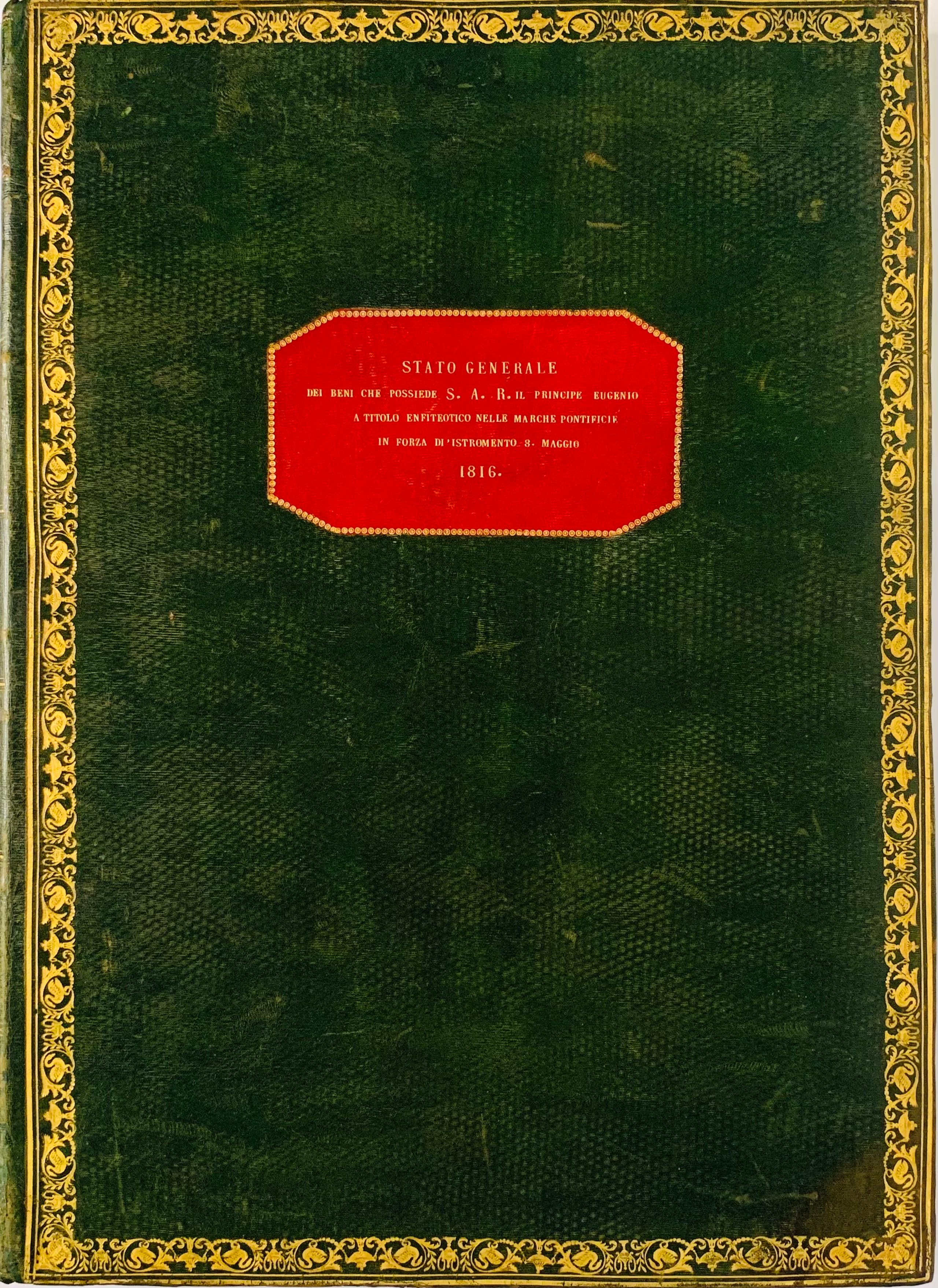
Titled on the front cover: “STATO GENERALE dei beni che possiede S.A.R. Il Principe Eugenio a titolo enfiteotico nelle Marche pontificie, in forza di istromento 8 maggio 1816” (GENERAL STATEMENT of the property owned by Prince Eugene under a emphyteutic lease in the Papal States, pursuant to the deed of 8 May 1816”).
Large folio, 109 printed pages with handwritten additions, numbered 1 to 103, 6 unnumbered, page 21 blank.
Bound in long-grain green morocco, smooth gilt-tooled spine, gilt framing on the covers comprising fillets and a scrollwork border with vases and swans framing the covers, guilloché corners, red title label on the front cover.
The properties listed here are documented by their specific names or by the place names where they are located, with the full names of their tenants. They are classified by former owners (the religious institutions dispossessed of these properties in 1810), which are themselves classified by the five districts forming the Papal States, namely Ancona, Jesi and Loreto, Senigallia, Pesaro, and Chiaravalle.
Only two copies of this document were produced: the first for the papal services (now kept in the Vatican archives), the other for Prince Eugene’s use.
The papal manuscript, dated 22 June 1817, is signed jointly by the treasurer general of the Apostolic Chamber (the future Cardinal Cesare Guerrieri Gonzaga), by the general accountant of the Apostolic Chamber (Saverio Benucci), and by Count Antonio Rè, who, during the Empire, had been the intendant of Prince Eugene’s appanage. He was the nephew by marriage of the former chancellor and keeper of the seals of the Kingdom of Italy, Francesco Melzi d’Eril.
This manuscript for Prince Eugene is signed by Count Antonio Rè. A few notes were added slightly later in the column reserved for comments. These indicate, on the one hand, the properties whose income was allocated to Prince Eugene’s son Maximilian (who became a Russian prince through his marriage to a daughter of Tsar Nicholas I) and, on the other hand, those that were sold, with the names of the buyers specified, for example the Bishop of Recanati, the Marquis Solari, and Count Ferretti.
In 1805, Napoleon I transformed the Italian Republic, which had emerged from the revolutionary wars, into the Kingdom of Italy, seized the crown, but entrusted the viceroyalty to his adopted son, Prince Eugène de Beauharnais, born from the first marriage of Empress Joséphine. On 15 March 1810, he enacted the Ninth Constitutional Statutes of the Kingdom of Italy, which granted Prince Eugene an ‘apanage’. This private domain, valued at ten million Italian lire, was essentially based on nationalised ecclesiastical property, particularly in the Papal States, territories occupied since 1807 and annexed to the Kingdom of Italy on 2 April 1808 – religious congregations were abolished there in April 1810.
Thanks to the support of his father-in-law, the King of Bavaria, but above all thanks to Tsar Alexander I’s friendship with the Beauharnais family, Prince Eugene was not entirely stripped of his possessions when the Empire fell. Although he never obtained a principality in Italy as he had hoped, due to opposition from Metternich, on 31 May 1814, the Treaty of Fontainebleau guaranteed him ‘a suitable establishment outside France’ (Article VIII).