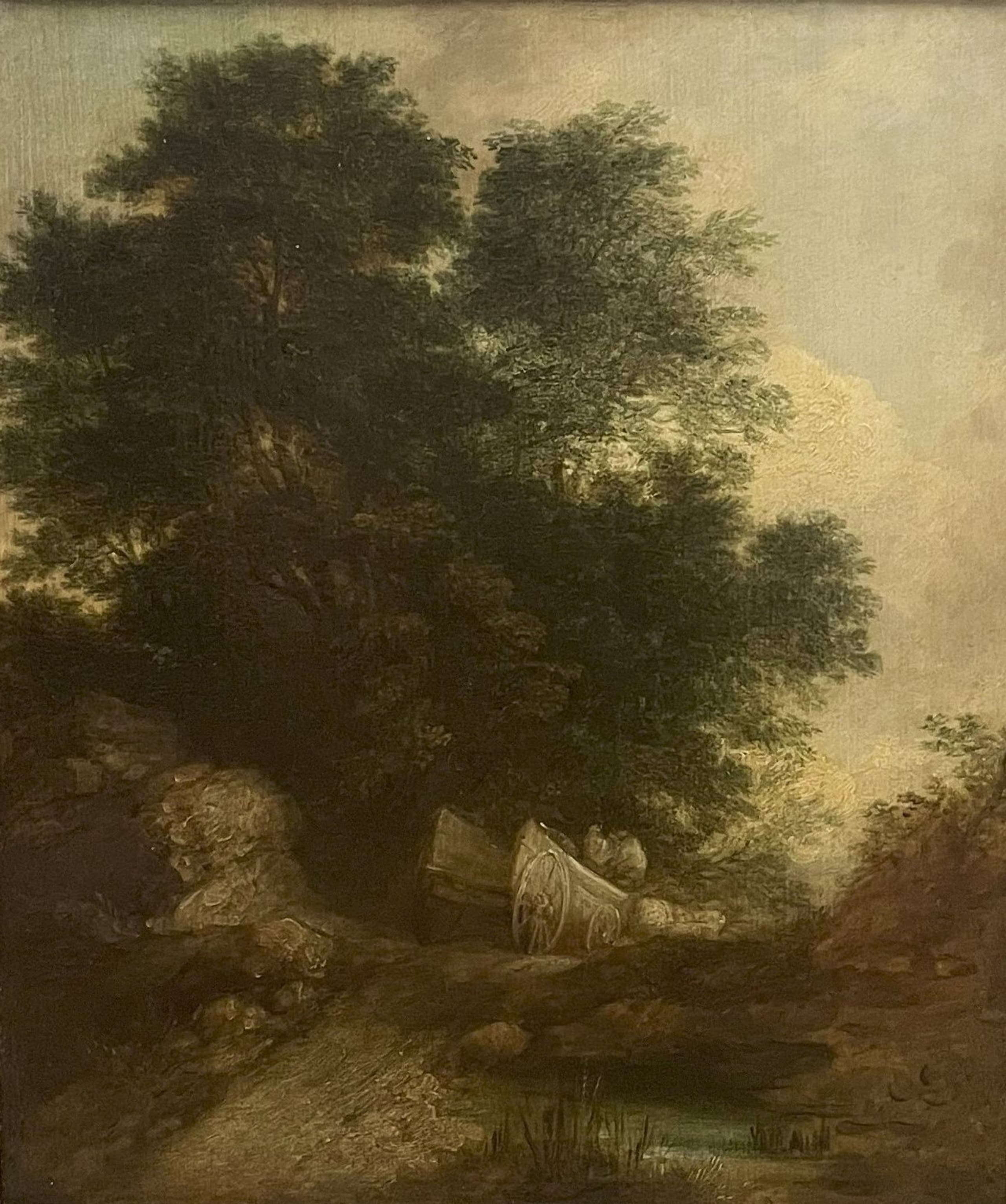
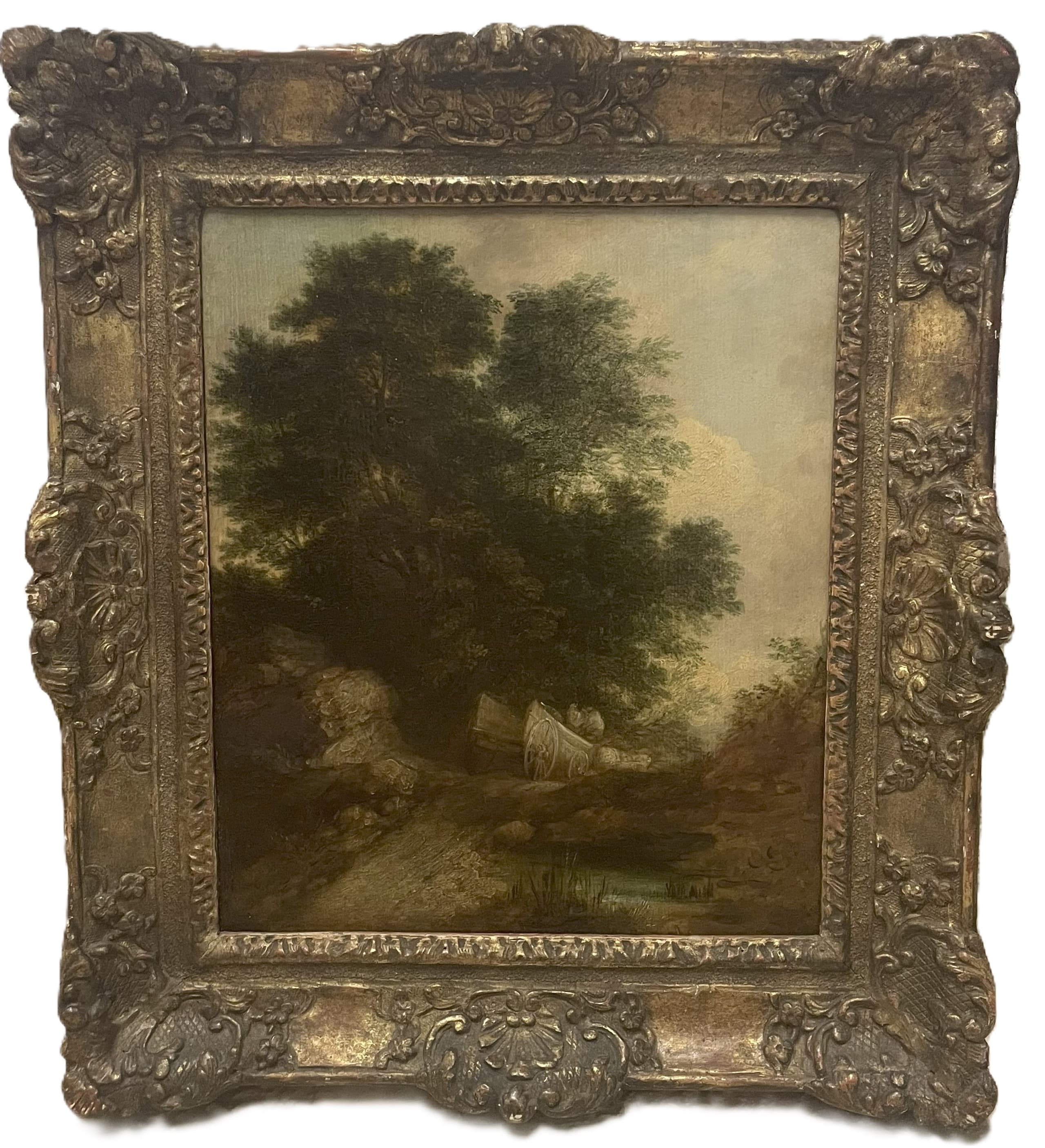
THOMAS GAINSBOROUGH R.A. (1727 - 1788) Wooded landscape with Peasants in a wagon
Lotto 356
65 00075 000
oil on panel
35.5 x 29.8 cm.
PROVENANCE:
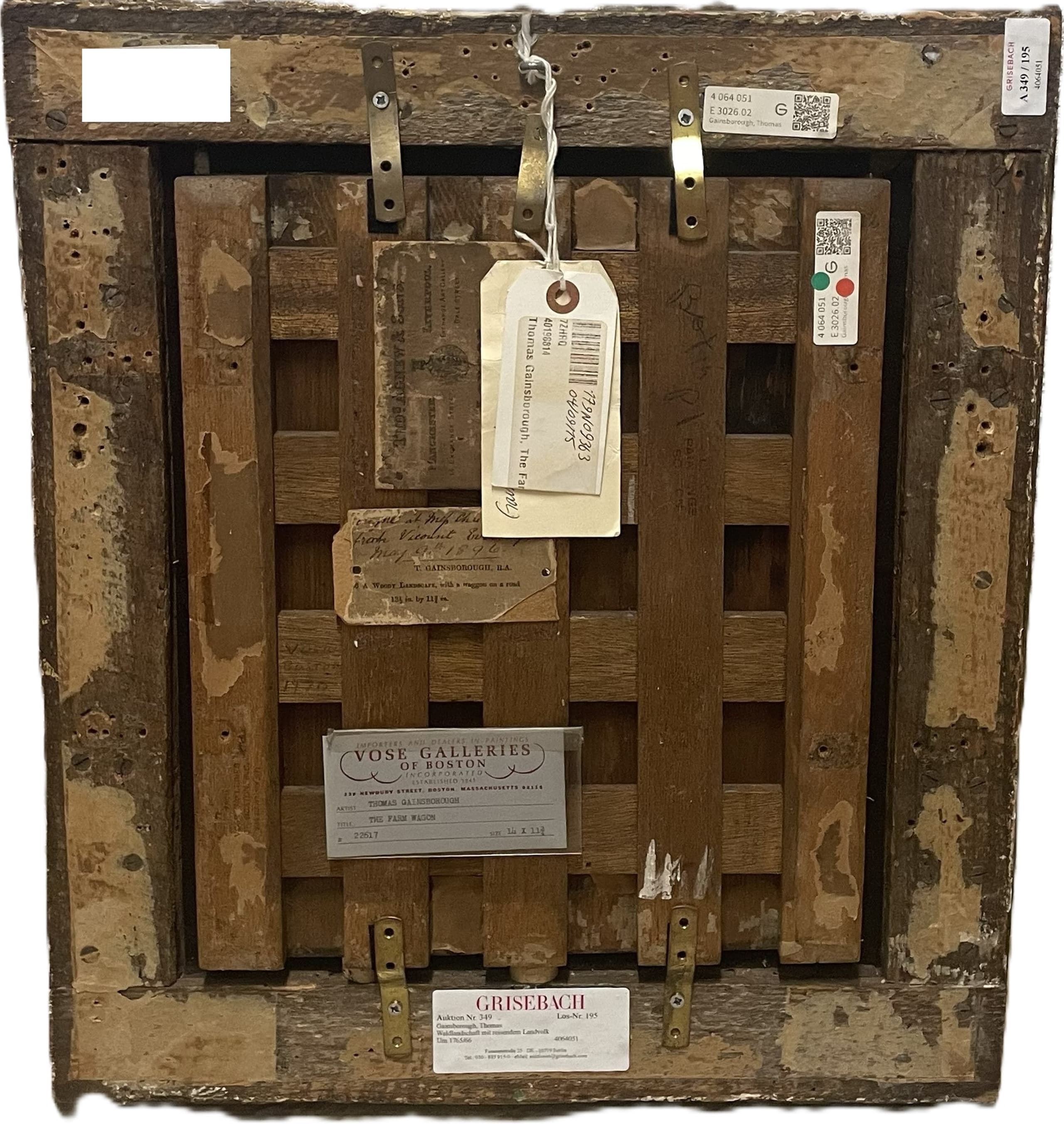
Charles, Viscount Eversley (1794-1888); By whose Estate sold, London, Christie’s, 9 May 1896, lot 56, to Agnew; With Thos. Agnew & Sons, London;
With Howard Young, New York, by 1928;
With Robert C. Vose, Boston;
From whom purchased by Miss Helen Norton, Boston and Montreal, 19 January 1931; Purchased from her executrix, Verina L. Thornton, by Vose Galleries, Boston, 24 May 1968; With Vose Galleries, Boston;
Anonymous sale
Private collection
LITERATURE:
‘Notable Works of Art now on the Market,’ in The Burlington Magazine (Advertisement Supplement), December 1969, reproduced plate LXXIV;
J. Hayes, The Landscape Paintings of Thomas Gainsborough, A Critical Text and Catalogue Raisonné, Ithaca 1982, vol. II, pp. 425-426, cat. no. 86, reproduced (as not seen, painted circa 1765-6; incorrectly listed as oil on canvas).
The art historian and leading Gainsborough specialist John Hayes links this painting to a large-scale composition titled Forest Landscape with Cart, Milkmaid and Herd, exhibited by Gainsborough at the Society of Artists in 1766. As part of his working method in the mid-1760s, Gainsborough frequently produced small-scale model landscapes, which allowed him to experiment with structure and composition. In small paintings like this one, created in the mid-1760s, Gainsborough experimented with simple and complex compositions, with increased emphasis on the depiction of trees and foliage. Creating small landscapes to see the overall pattern and intent became his preferred method of working.
Gainsborough also often turned to the works of seventeenth-century Dutch landscape painters for inspiration, particularly the works of Pieter Molijn (1595–1661), whose paintings were included in Gainsborough’s personal collection. The present work appears to have been inspired by a composition attributed to Molijn. Massive trees dominate the left side of the canvas, while the composition opens to a receding landscape at right—an arrangement that Gainsborough expanded in the final exhibited version by filling both sides and the upper portion of the canvas with dense, textured foliage. The result evokes the brooding grandeur of Jacob van Ruisdael, another Dutch master whose influence is evident in the dramatic treatment of light and shadow.
Although he is best known for his portraits, Gainsborough considered himself primarily a landscape painter. However, landscapes were not popular in England at the time, so the artist mainly earned his income from portraits. Gainsborough skilfully combined the realism of Dutch landscapes with the lightness and decorative style of French ones. His style of painting became increasingly broad and free, and the colour palette more fluid.
The interplay of light and shadow in the dense foliage is dramatic, but this is balanced by the landscape’s overall lyrical mood. The lightness of the brushstrokes and the freedom of the painterly style obscure the compositional clarity. Light plays the main role here. For the first time, it begins to play a constructive role. The landscape is permeated with light, but it is not bright; it is the scattered light characteristic of the English sky.
This light is the main innovation that Gainsborough brought to landscape painting, paving the way for its further development through to Romanticism and the works of John Constable, who was an admirer of Gainsborough’s work.
This work is to be included in the forthcoming catalogue raisonné of Gainsborough’s paintings, under the direction of Hugh Belsey.