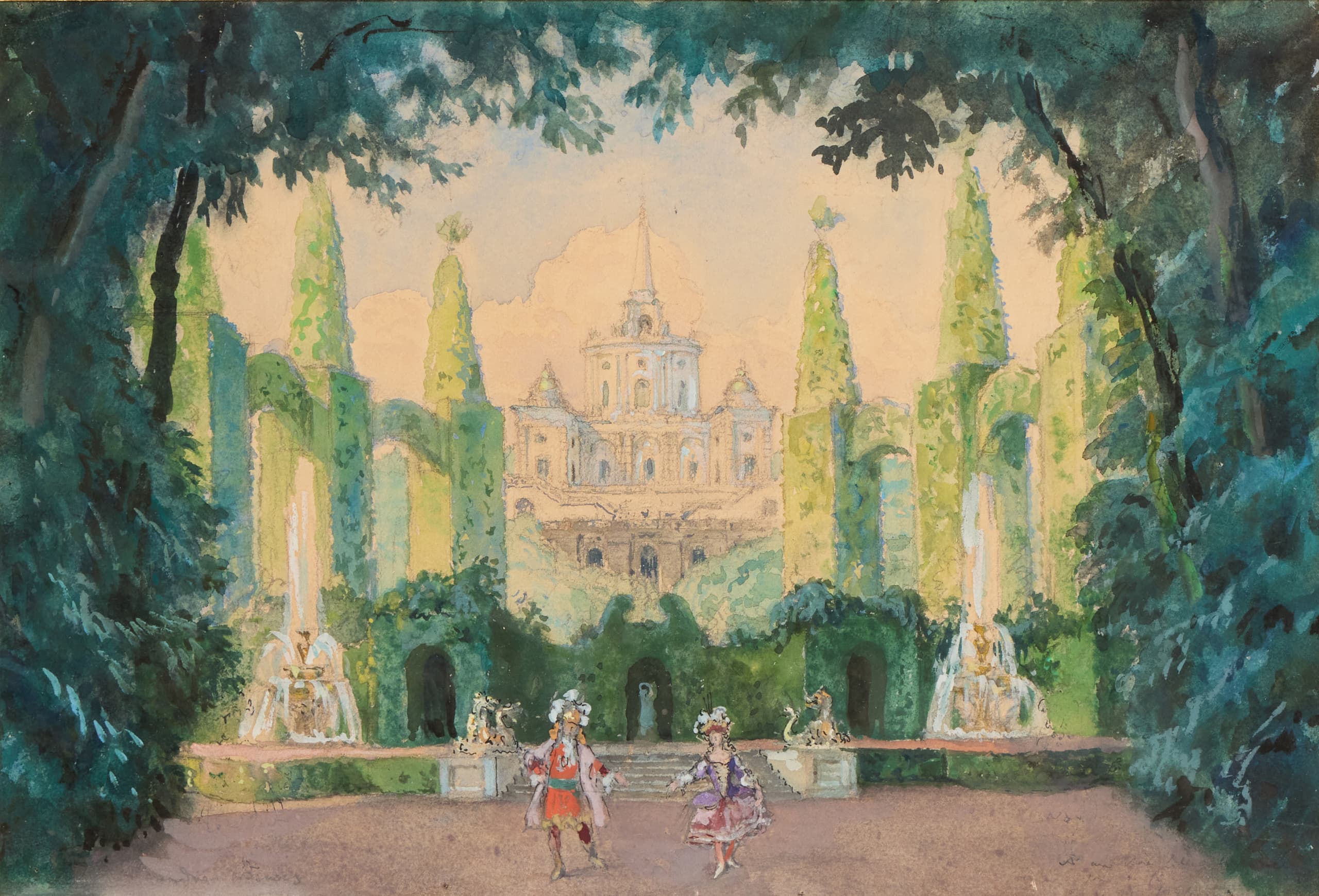
ALEXANDRE BENOIS (1870-1960) Stage design for the ballet 'Le Pavillon d'Armide', choreographed by Michel Fokine
Lot 11
12 00015 000
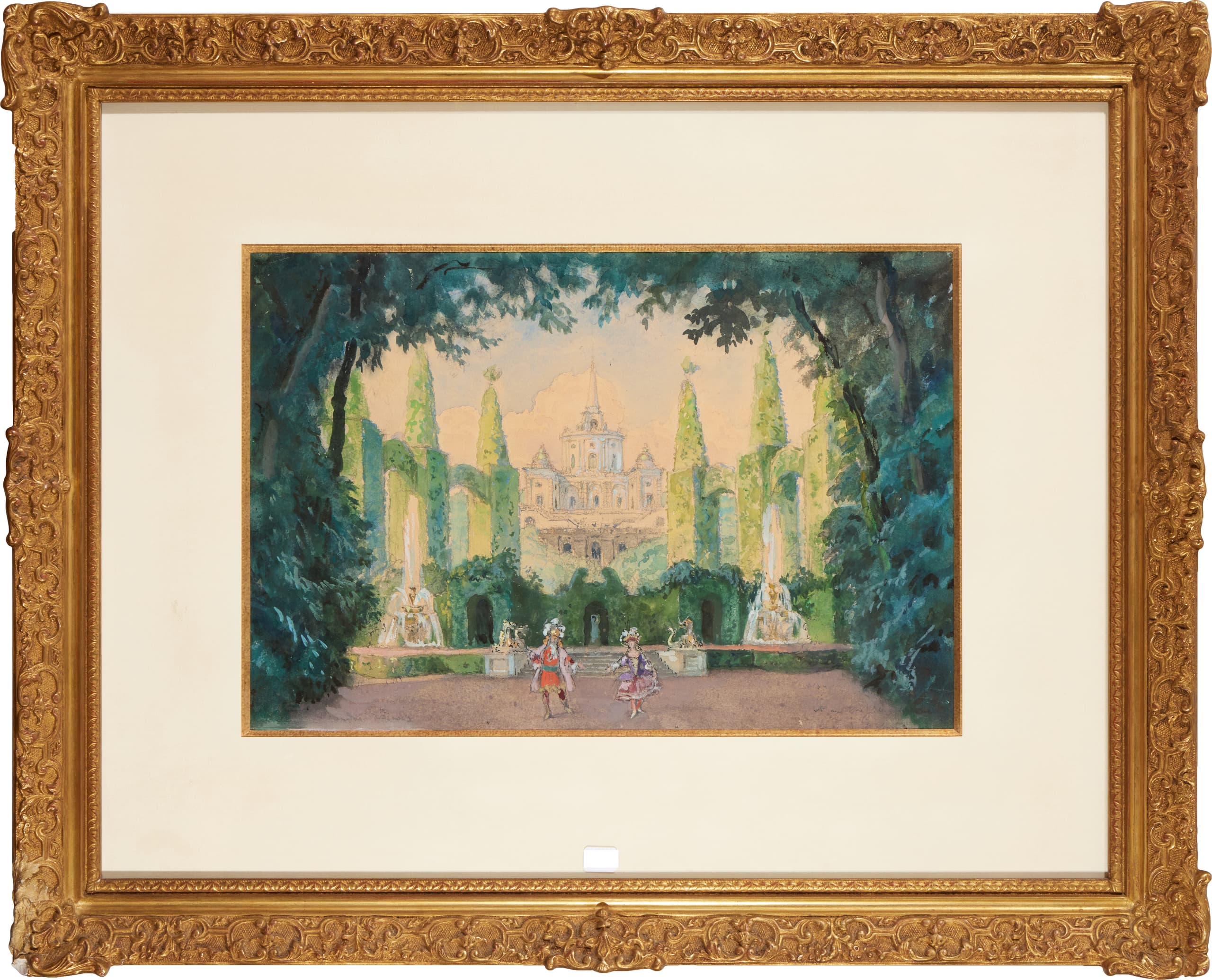
signed in pencil 'Alexandre Benois' (lower left); dedicated and dated 'A ma chère fille Hélène….1944' (lower right)
watercolour, gouache, ink on paper
32.5 x 47.5 cm
executed likely circa 1907-1909
Provenance:
Elena Benois (Hélène Clément-Benois) (1898-1972), and by descent to her family;
Private collection
First premiered in 1907 at the Mariinsky Theatre in St Petersburg, Le Pavillon d'Armide is a one-act ballet in three scenes with music by Nicolas Tcherepnine and a libretto by Alexandre Benois, inspired by Théophile Gautier's 1834 novella Omphale. The set designs and costumes by Alexandre Benois and choreography by Michel Fokine, with Anna Pavlova in the role of Armide, Vaslav Nijinsky as the Slave, and Pavel Gerdt as the Vicomte René de Beaugency.
In 1909, the ballet was transferred to the Théâtre du Châtelet in Paris, where it became the first production staged by Sergei Diaghilev's Ballets Russes.
Armide was performed by Vera Karalli, with Mikhail Mordkin as the Vicomte and Nijinsky reprising his role as the Slave.
This was the first ballet presented in Paris by Diaghilev. Its success was due in part to its French theme. The 1909 season also featured works inspired by Russian folklore that were similarly well-received.
The ballet is set during the reign of Louis XIV, when the young Vicomte René de Beaugency seeks shelter from a storm in the castle of the magician Marquis de Fierbois. Spending the night in Armide's Pavilion, he dreams that a Gobelins tapestry comes to life, bringing the enchantress Armide and her court to life. He falls in love with her and receives her scarf as a token. When he wakes, he finds the scarf in his possession and the tapestry changed, suggesting that his dream was real.
Benois's designs reflect his engagement with eighteenth-century French art, particularly the Rococo decorative tradition of Jean Bérain and Louis-René Boquet. The stage is conceived as a unified decorative environment and by the motif of the animated tapestry with heighten the interplay between illusion and reality.
The date of 1944 corresponds to the dedication date to Hélène Clément, the youngest daughter of Alexandre Benois. The watercolour itself was most likely executed between 1907 and 1909.