EMILE GALLE (1846-1904) Mahogany vitrine with a marquetry decoration of apple blossoms
Lot 57
12 00012 500
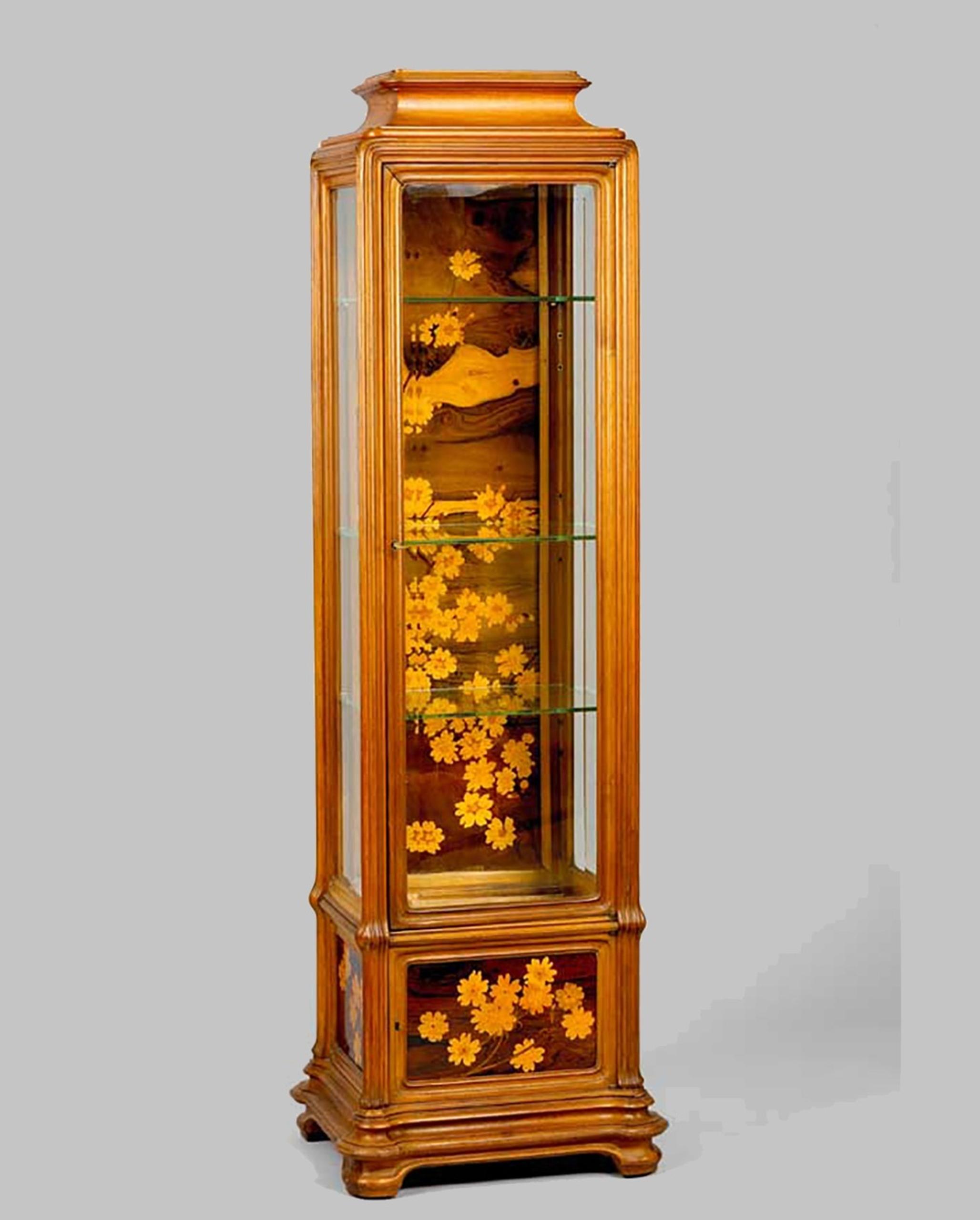
signed in the marqueterie ‘Gallé’
150 x 40 x 30 cm
Executed circa 1900
Émile Gallé was born in Nancy on May 4, 1846. He was a French industrialist, glassmaker, cabinetmaker and ceramist. He was was one of the most important figures in the applied arts of his time and one of the pioneers of Art Nouveau, one the founder (with Victor Prouvé, Louis Majorelle, Antonin Daum et Eugène Vallin) in 1901 and first president of the Ecole de Nancy.
After his studies and various apprenticeships abroad, he returned to Nancy where, having new ways of exploring the technique of glass, he set about imitating nature with striations, knots, splinters, reflections, shadows and marbling. After his participation in the Universal Exhibition of 1878, his fame spread throughout the world and he became one of the most famous glass artists in the world.
Although Gallé was trained in cabinetmaking at an early age, he did not become involved in it until relatively late in his career. Needing to make a base for a glass work, he went to a wood dealer and was amazed at the colorful shades of this material. He opened a cabinetmaking workshop in 1884, which produced both small, inexpensive furniture and luxury sets and furniture. In 1889, the workshop had a catalogue of more than 600 types of wood, in particular oak, walnut, ash and plum.
His collections based on umbels and meadowlarks were a great commercial success at the beginning of the 20th century, with the art factory adapting Gallé’s designs for a sideboard to other pieces of furniture (wardrobe, chest of drawers) in order to meet demand.
He carried out numerous technical experiments, particularly in the field of marquetry: he experimented with the different properties of wood from the same tree, exploiting its defects and sometimes playing with colored waxing, staining, shading or introducing mother-of-pearl and metal into the material. His style, originally inspired by the Renaissance and the eighteenth century, evolves more and more towards naturalism and the exploitation of plant forms.